Active GEM funds went into October’s election with Brazil as their most widely held overweight
28 October 2026 · Steven Holden · Data to 30 September 2026
Overview
Positioned for the vote
Brazilians went to the polls on 4 October, and President Lula went on to secure a fourth term in a close runoff against Flávio Bolsonaro on 25 October. This piece sets out how 353 active GEM funds, managing $697bn, were positioned in Brazil going into the vote, using holdings data to 30 September 2026.
The short answer is heavily. Brazil was the largest country overweight in the GEM universe, held overweight by more funds than any other market, with a record $42.4bn invested. Its weight did fall over the six months prior, but that was the Korean and Taiwanese semiconductor rally at work: buyers matched sellers and net flows were close to zero. Beneath the surface, managers were rotating into Energy, Materials and Utilities, and into names such as Nu Holdings, Embraer and Vale.
01 · Country positioning
Positioning snapshot
EM's favourite overweight
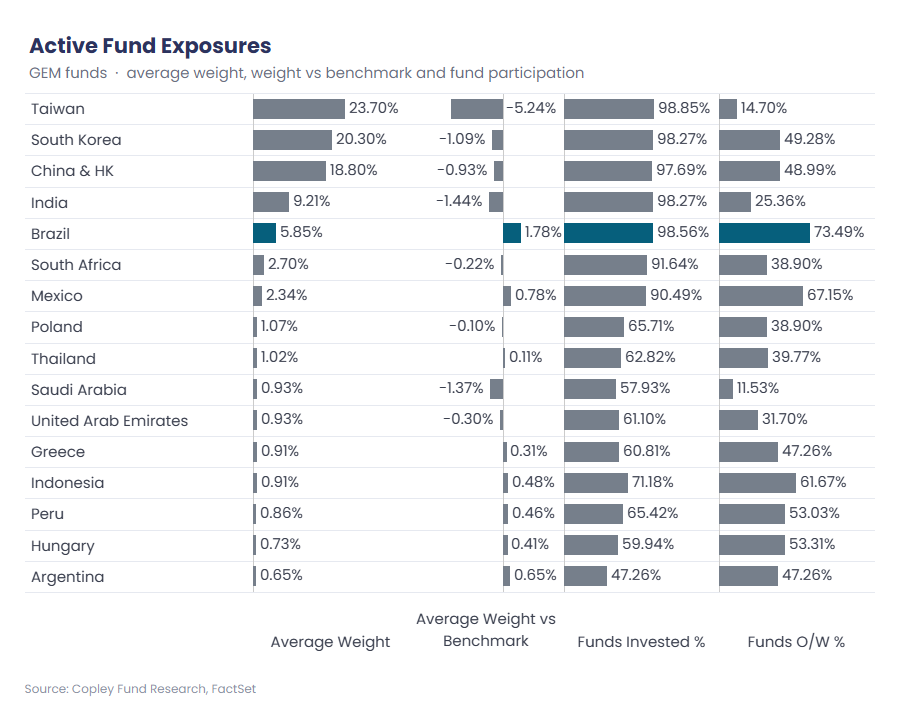
Brazil carries an average weight of 5.85%, the fifth-largest country allocation in GEM behind Taiwan, South Korea, China & HK and India. Relative to the benchmark it stands out: the average fund is 1.78% overweight, the largest country overweight in our universe, and 73.5% of funds hold more Brazil than the index, more than for any other market.
Participation is close to universal, with 98.6% of funds holding at least one Brazilian stock, second only to Taiwan.
Positioning over time
An overweight built since 2021
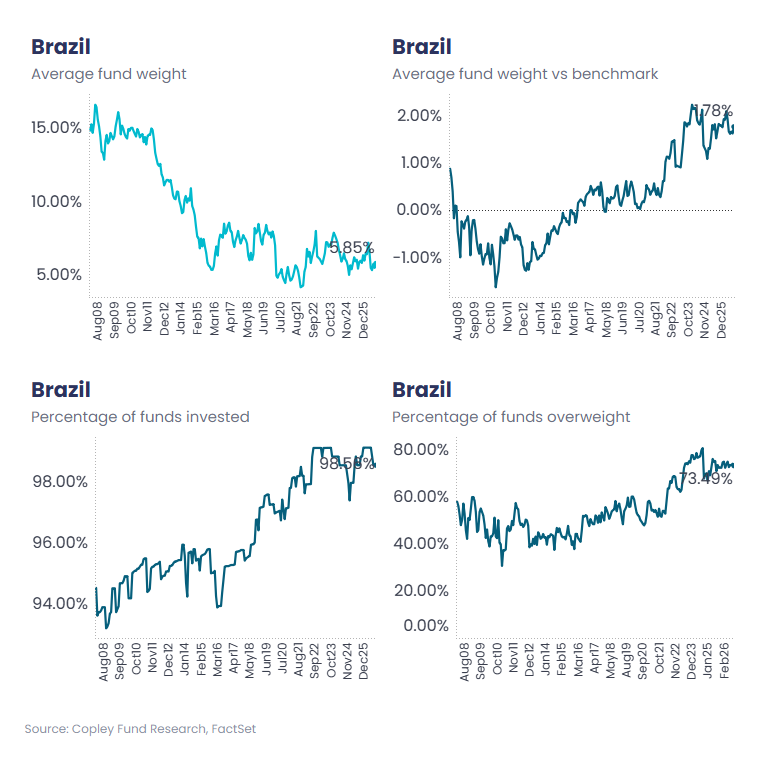
Absolute weights are a fraction of the 15% seen in 2008–2011, when Brazil was the cornerstone of most EM portfolios. Relative positioning tells a different story. Funds moved from a persistent underweight in the early 2010s to overweight from 2016, and the gap widened sharply from 2021.
The share of funds overweight has climbed from around 40% to nearly three-quarters, close to its record, while fund participation sits near an all-time high.
02 · Rotation
Positioning changes
Weights fell, activity balanced
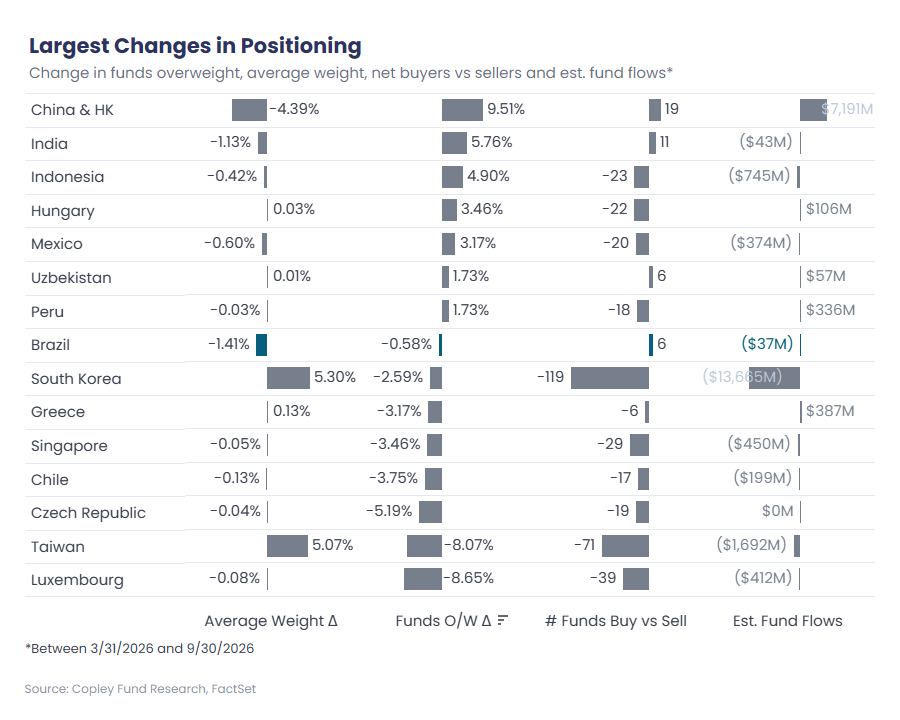
Brazil’s average weight fell by 1.41% between March and September, the second-largest fall of any country after China & HK. But the benchmark weight fell almost as far, leaving the overweight just 0.33% lower.
This appears more a market move than a manager move. Korea and Taiwan gained more than 5% each as semiconductors rallied, diluting everything else. Over the same period 142 funds bought Brazilian stocks and 136 sold, and estimated net flows were just -$37m against $42.4bn invested.
Fund rotation by sector
Where funds moved within Brazil
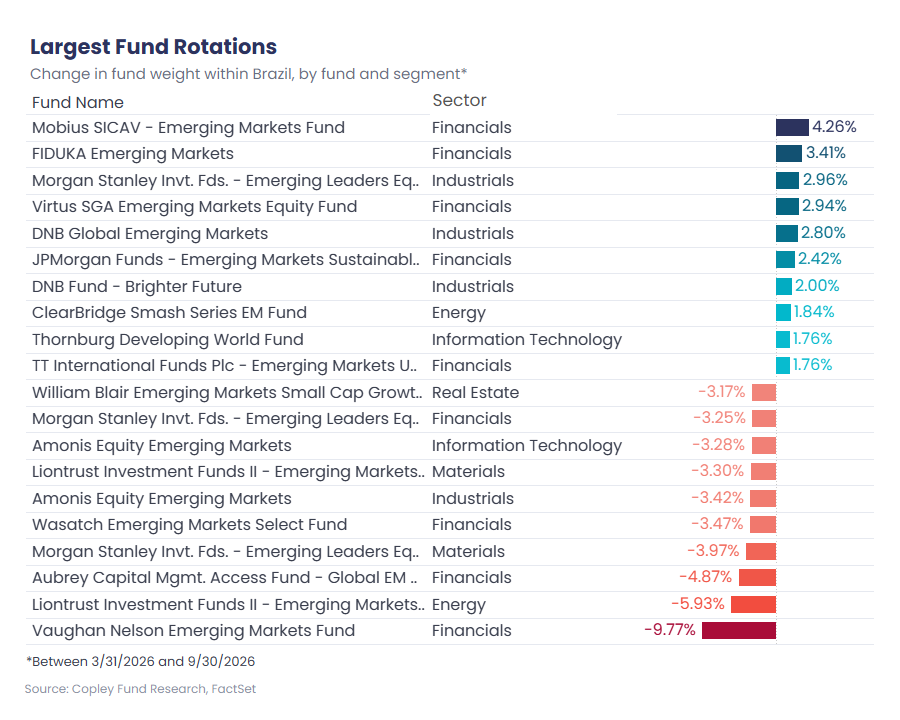
The chart shows where those moves occured at the sector level. The largest increases were new positions in Brazilian Financials, led by Mobius EM (+4.26%) and FIDUKA (+3.41%), and in Industrials at Morgan Stanley EM Leaders (+2.96%) and DNB Global EM (+2.80%). On the other side, Vaughan Nelson’s exit from Financials (-9.77%) and Liontrust’s closure of its Energy position (-5.93%) were the largest reductions.
03 · Sector positioning
Sector snapshot
Financials the anchor, overweight almost everywhere
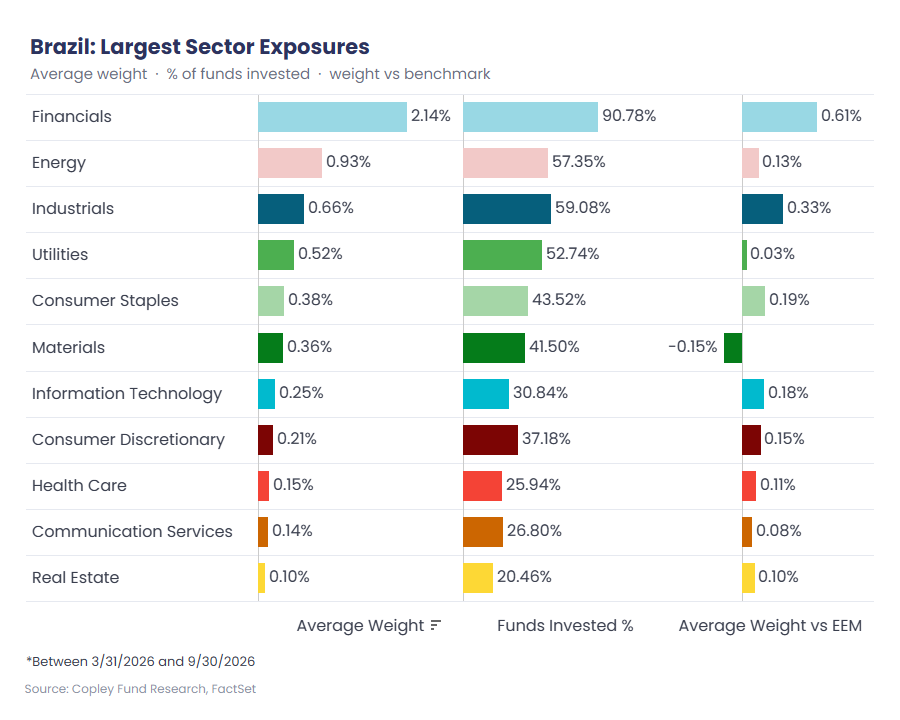
Financials dominate at 2.14% average weight, held by 90.8% of funds and 0.61% overweight the benchmark. Energy (0.93%) and Industrials (0.66%) follow. Funds are overweight every Brazilian sector except Materials, where Vale’s underweight leaves a modest -0.15% gap.
The six-month changes point to rotation rather than retreat. Financials saw the largest decline (-0.41%). Materials drew the largest inflows (+$337m) and a 2.9% rise in funds overweight, and Energy added 2.3% more funds. Consumer Staples was sold the hardest, with 33 more sellers than buyers, $266m of outflows and 5.8% of funds exiting (see charts in data pack)
Sector ownership over time
Energy and Utilities return, Staples fade
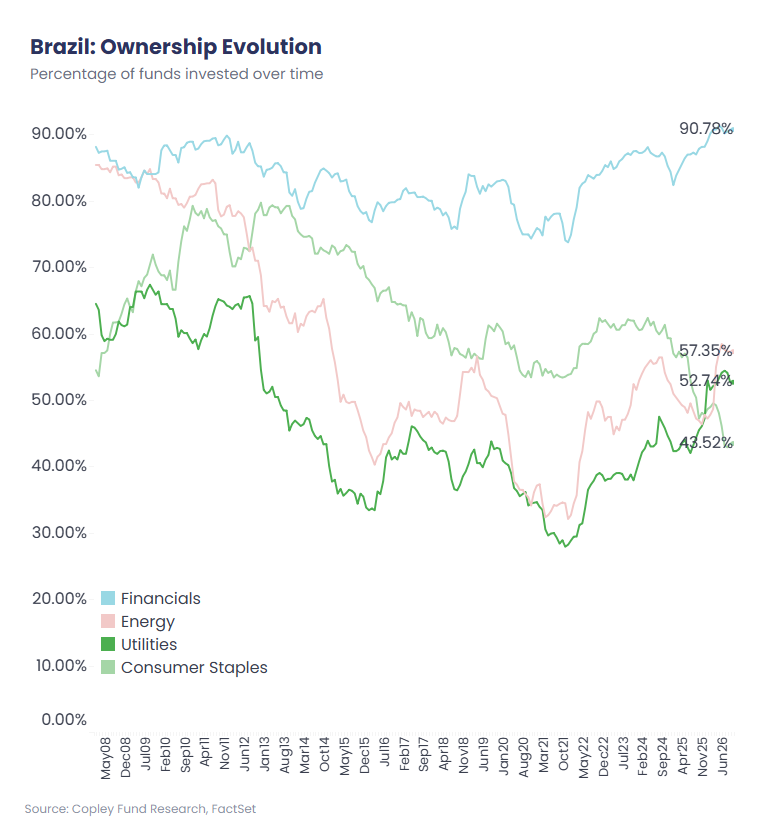
Energy ownership collapsed from more than 80% of funds in 2008 to roughly a third in 2021, and has since rebuilt to 57%. The sector has now moved overweight the benchmark for the first time in our data. Utilities show a similar recovery, from below 30% of funds in 2021 to 53% today.
Consumer Staples is heading the other way, with ownership down to 43.5% from around 60% three years ago. Financials participation, at 90.8%, sits close to its record.
04 · Distribution and style
Holdings distribution
The more active, the bigger the bet
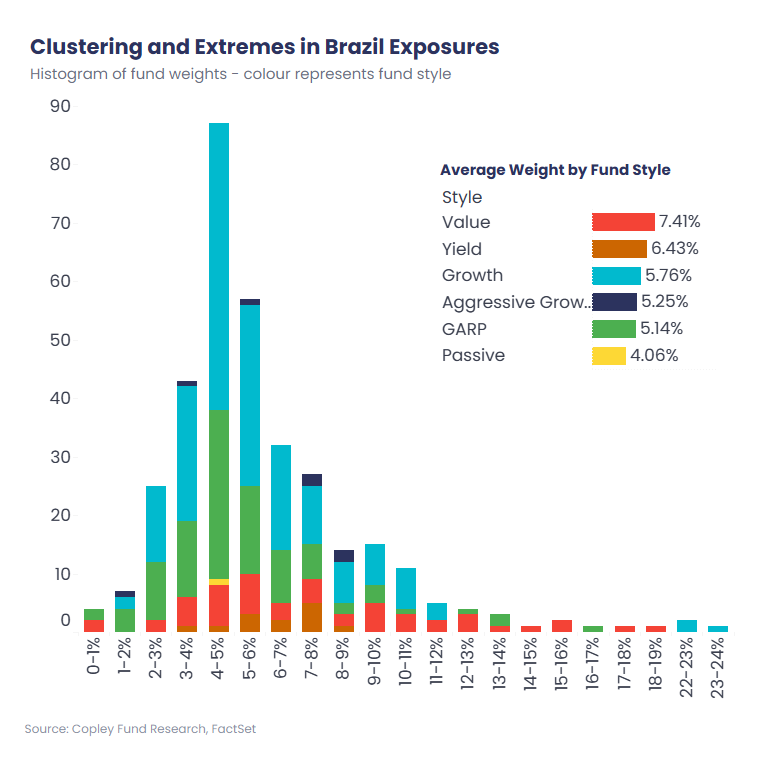
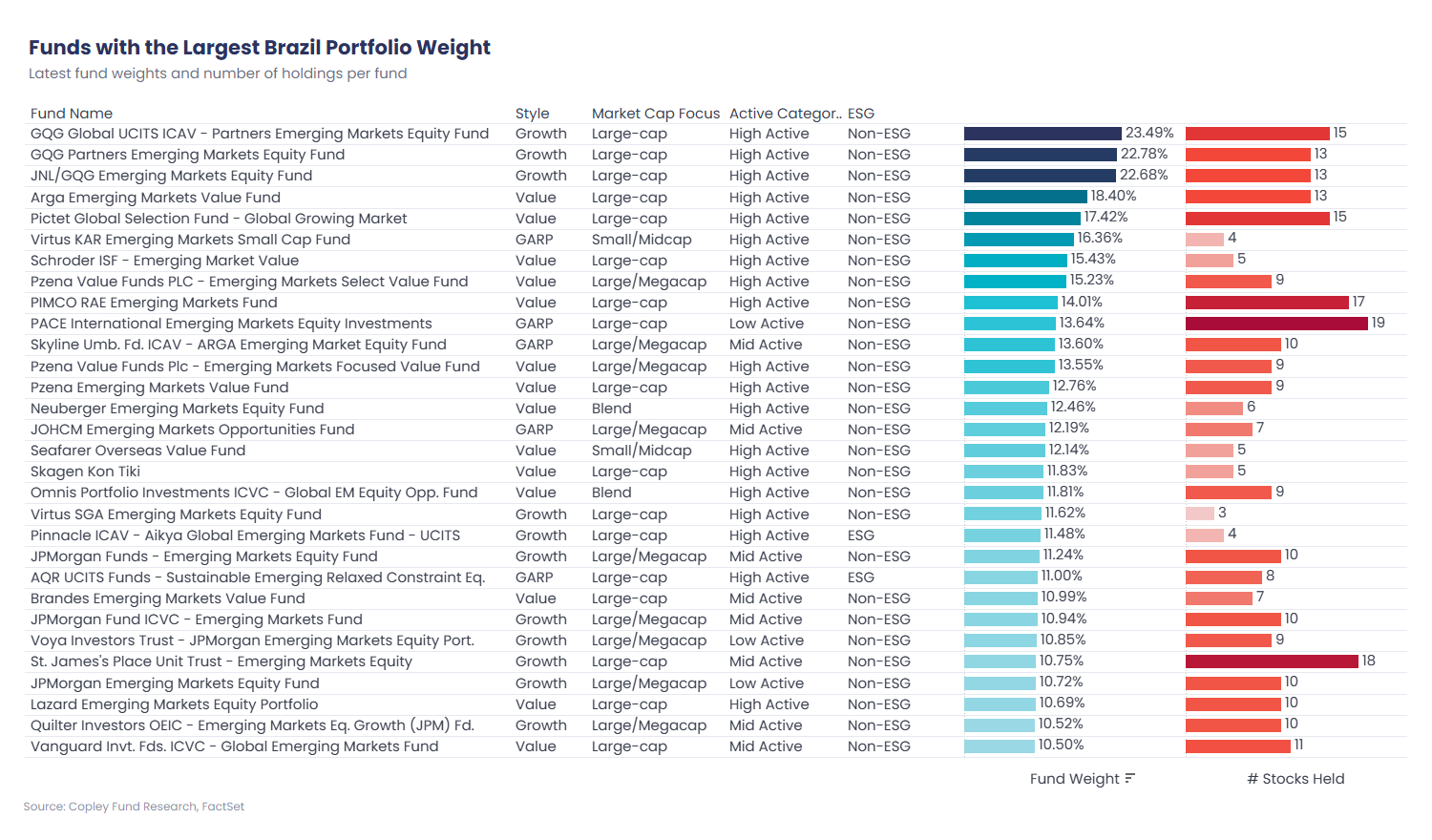
The largest cluster of funds holds between 4% and 6% in Brazil. The median is 5.06%, the interquartile range runs from 4.02% to 7.04%, and a long tail of high-conviction funds reaches 23.5%.
Conviction rises with activeness. High Active funds average 8.22% in Brazil, against 5.91% for Mid Active, 4.75% for Low Active and 4.06% for passive. By style, Value funds lead at 7.41%, followed by Yield at 6.43%. Every style group holds more Brazil than the passive benchmark.
Style evolution
Value leads the overweight
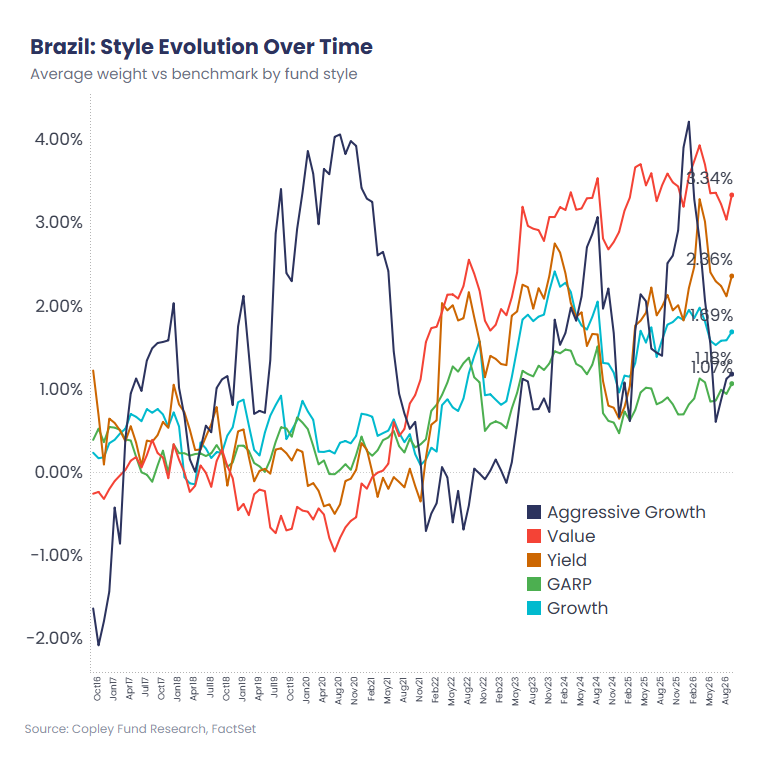
For much of the last fifteen years, style groups moved together on Brazil. Since 2022 they have diverged, with Value managers building the largest overweight at more than 3% above the benchmark. Yield is next at more than 2%, with Growth, Aggressive Growth and GARP between 1% and 2%.
05 · Top investors
Top investors
Conviction at the top
Three GQG strategies top the list, each with around 23% in Brazil. Arga EM Value (18.40%), Pictet Global Growing Markets (17.42%) and Virtus KAR EM Small Cap (16.36%) follow. Value managers make up much of the top twenty, including Neuberger EM Equity, three Pzena strategies and PIMCO RAE.
In dollar terms, GQG Partners EM Equity ($4.89bn) and American Funds New World ($4.88bn) are by far the largest holders, together accounting for almost a quarter of all active GEM money in Brazil.
06 · Stock holdings and activity
Most widely held stocks
Itaú, Nu and Petrobras lead
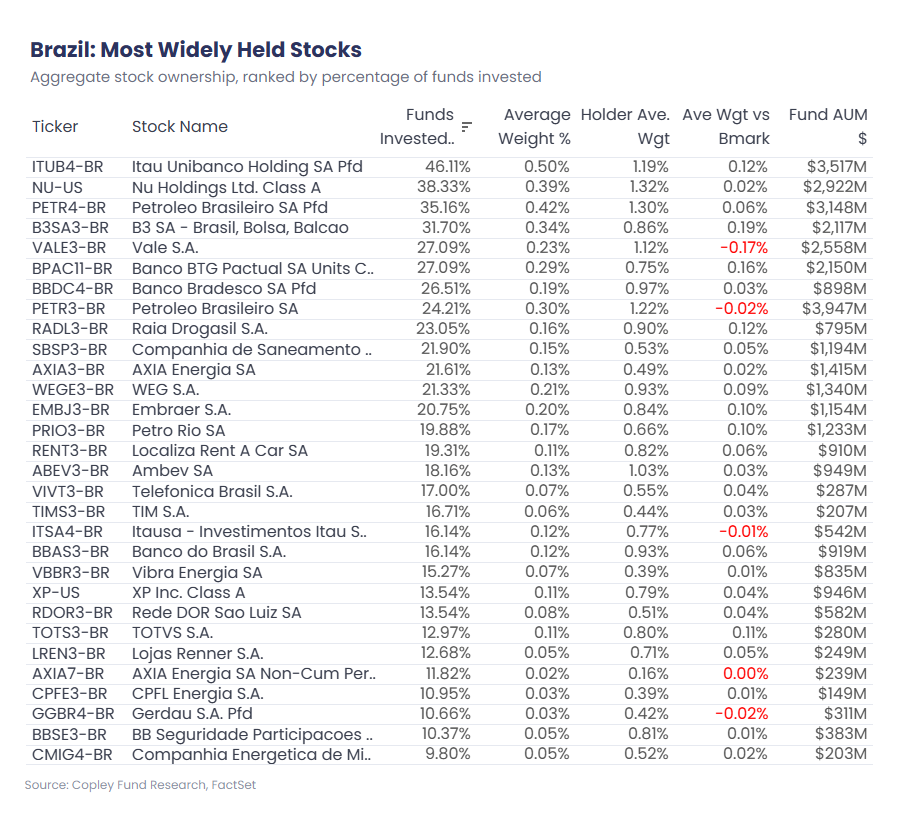
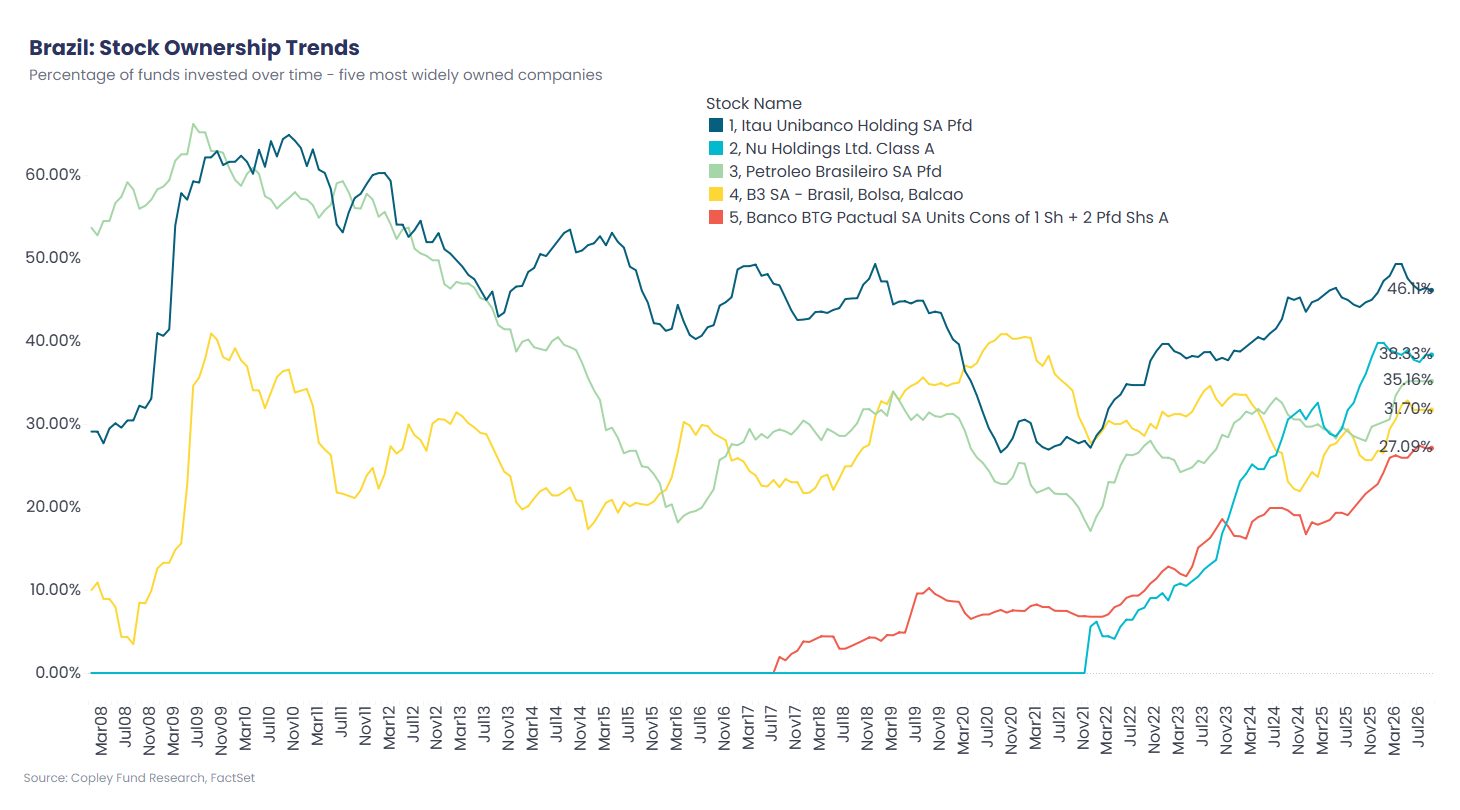
Itaú Unibanco is the most widely held Brazilian stock, owned by 46.1% of funds, followed by Nu Holdings at 38.3% and Petrobras preferred at 35.2%. B3 (31.7%), Vale and BTG Pactual (both 27.1%) complete the core.
The largest overweights are in the exchange and the banks: B3 (+0.19%), BTG Pactual (+0.16%) and Itaú (+0.12%), alongside Raia Drogasil and TOTVS. Vale is the largest underweight at -0.17%. Petrobras is the largest holding in dollar terms, with $3.9bn in the ordinary shares and $3.1bn in the preferred.
Stock rotation
Into Nu, Embraer and Vale; out of Petrobras preferred
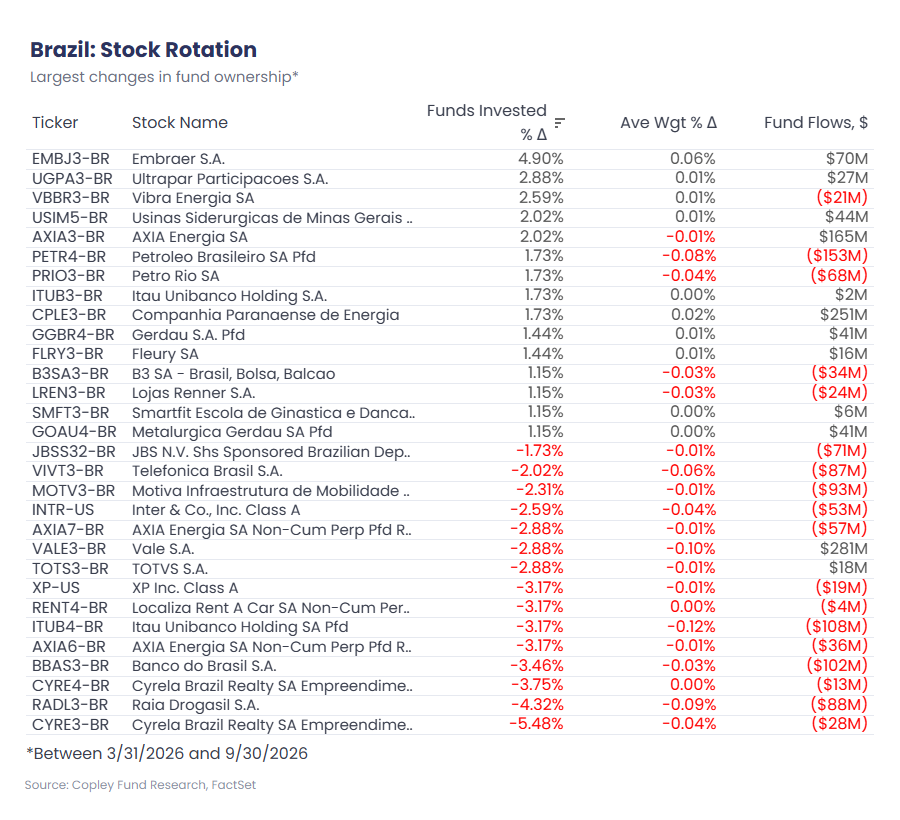
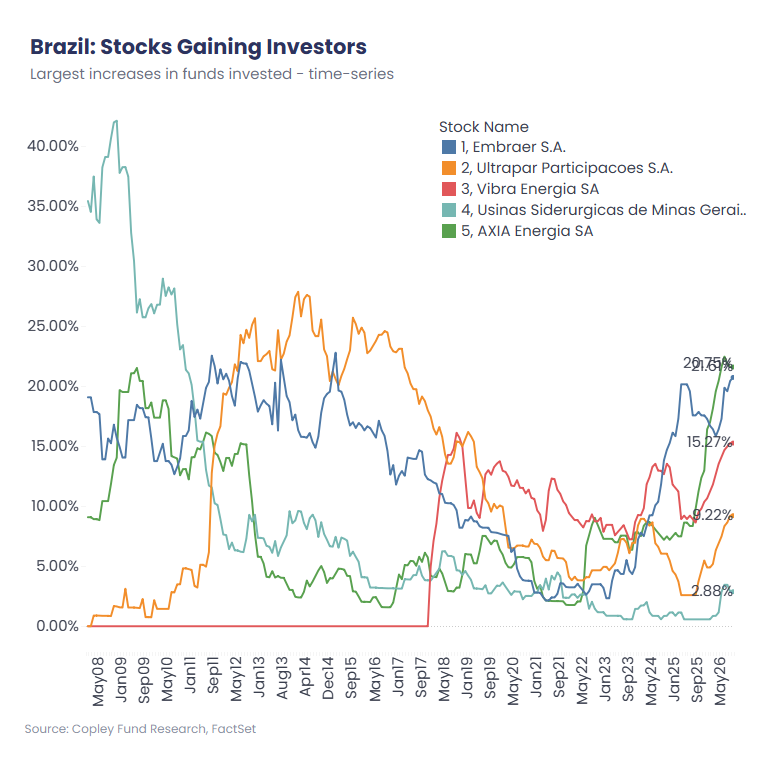
Embraer recorded the largest increase in ownership, held by 4.9% more funds than in March. Ultrapar (+2.9%) and Vibra Energia (+2.6%) followed. In dollar terms, Nu Holdings drew the largest net inflows at $379m, ahead of Vale ($281m), Copel ($251m) and Axia Energia ($165m).
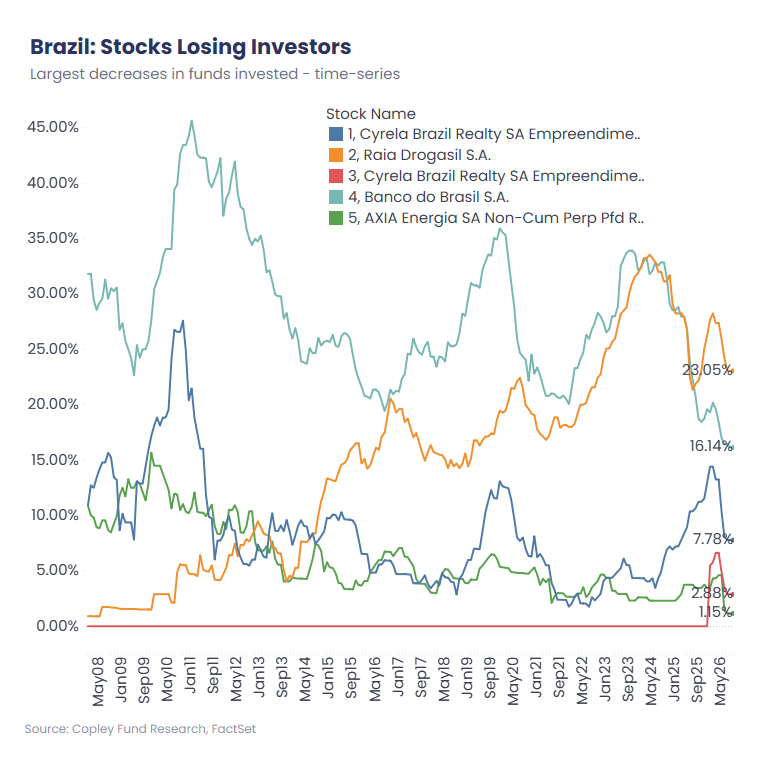
The sellers were concentrated in Petrobras preferred (-$153m), Bradesco preferred (-$134m), Ambev (-$123m) and Itaú preferred (-$108m). Cyrela (-5.5%), Raia Drogasil (-4.3%) and Banco do Brasil (-3.5%) lost the most holders.
07 · Fund-level positions
Fund-level stock positions
The highest-conviction single bets
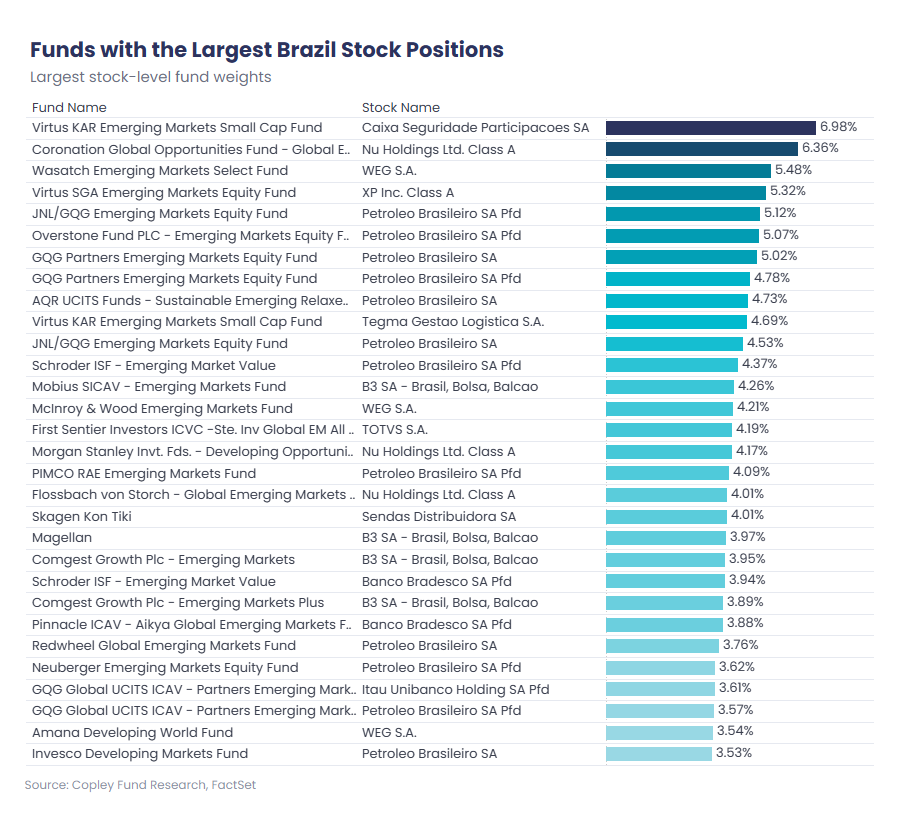
The largest individual positions sit outside the bellwethers. Virtus KAR EM Small Cap holds 6.98% in Caixa Seguridade, Coronation Global EM holds 6.36% in Nu Holdings and Wasatch EM Select holds 5.48% in WEG. Petrobras features repeatedly, with GQG, JNL/GQG and Overstone each holding around 5%.
Fund-level stock rotation
New positions in B3, Embraer and Nu
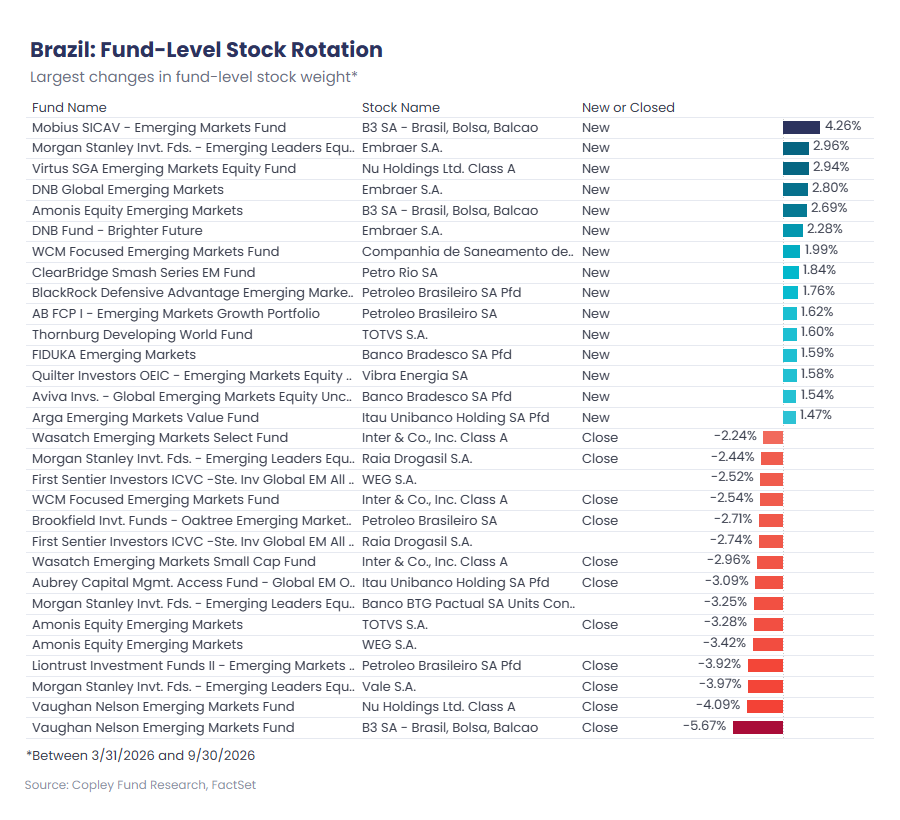
Mobius EM opened a 4.26% position in B3, Morgan Stanley EM Leaders and DNB Global EM both opened Embraer positions of close to 3%, and Virtus SGA added Nu at 2.94%. On the other side, Vaughan Nelson closed out B3 and Nu as it exited Brazil, while Morgan Stanley EM Leaders sold Vale and Liontrust EM closed Petrobras preferred.
The largest single dollar moves were American Funds New World adding $208m of Vale, and GQG closing Vale (-$145m) and trimming BTG Pactual and Itaú.
08 · Stock trends
Stock ownership trends
From commodities to fintech
The five most widely held names chart Brazil’s changing investment case. Petrobras preferred was owned by around 60% of funds in 2009 and fell below 20% by 2016 before recovering to 35%. Itaú peaked above 60% around 2010 and sits at 46% today.
The newer names show how quickly the opportunity set has shifted. Nu Holdings went from IPO in late 2021 to 38% of funds in under five years, and BTG Pactual has built from almost nothing since 2017 to 27%.
Stocks gaining investors
Embraer's second wind
Embraer is the standout. Ownership fell to around 2% of funds in 2021 and has since rebuilt to 20.8%, its highest in more than a decade. Vibra Energia (15.3%) and Ultrapar (9.2%) are also attracting renewed interest as funds add to Brazil’s energy distribution and infrastructure names.
Stocks losing investors
Consumer names lose ground
Raia Drogasil, a long-standing quality holding, has fallen to 23.1% of funds from a peak of more than 30% in 2024. Cyrela’s ordinary and preferred shares both saw sharp falls in ownership. Both moves are consistent with the wider retreat from consumer staples and domestic consumption.
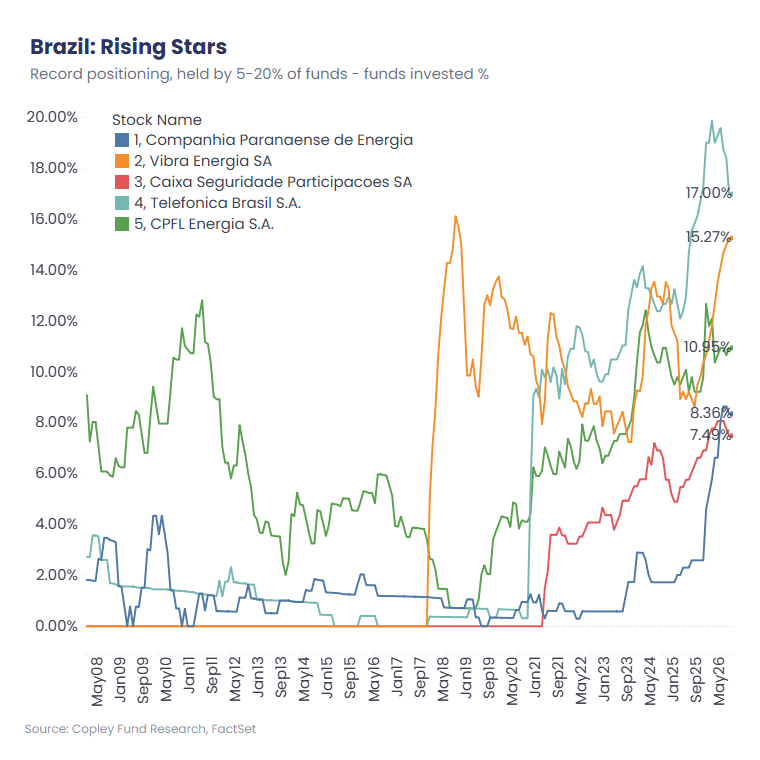
Rising Stars
Utilities and telecoms at record ownership
Five companies are at record levels of ownership while still held by fewer than one in five funds: Telefônica Brasil (17.0%), Vibra Energia (15.3%), CPFL Energia (11.0%), Copel (8.4%) and Caixa Seguridade (7.5%). Each is building a new investor base and may be an early signal of where Brazil’s next core holdings come from.
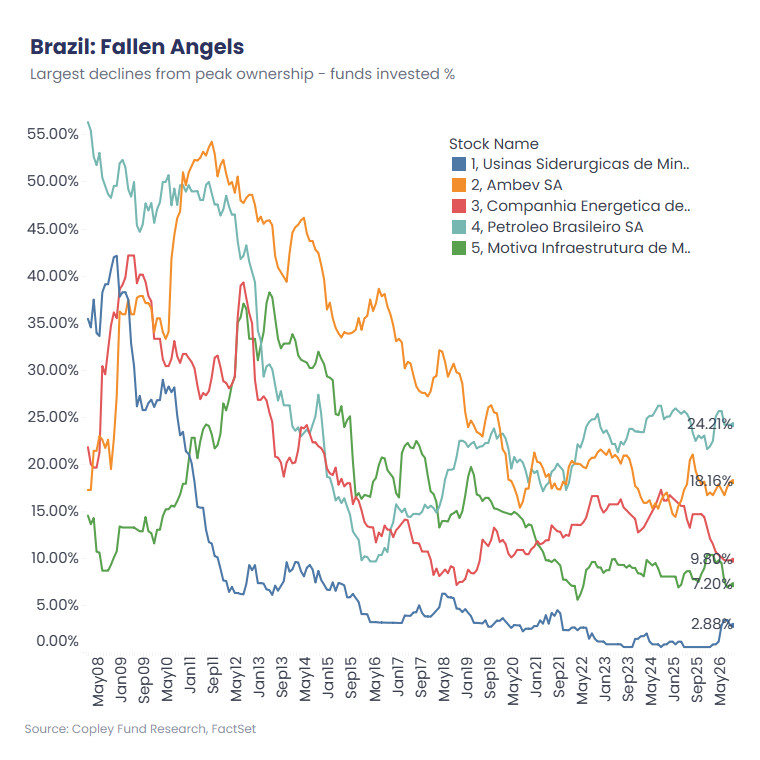
Fallen Angels
Former favourites now out of favour
At the other end of the spectrum, Usiminas has fallen from more than 40% ownership to 2.9%, Ambev from 54% to 18.2% and Cemig from 42% to 9.8%. Petrobras, while well off it’s former glory, remains invested by nearly a quarter of funds.
09 · Ownership cycles
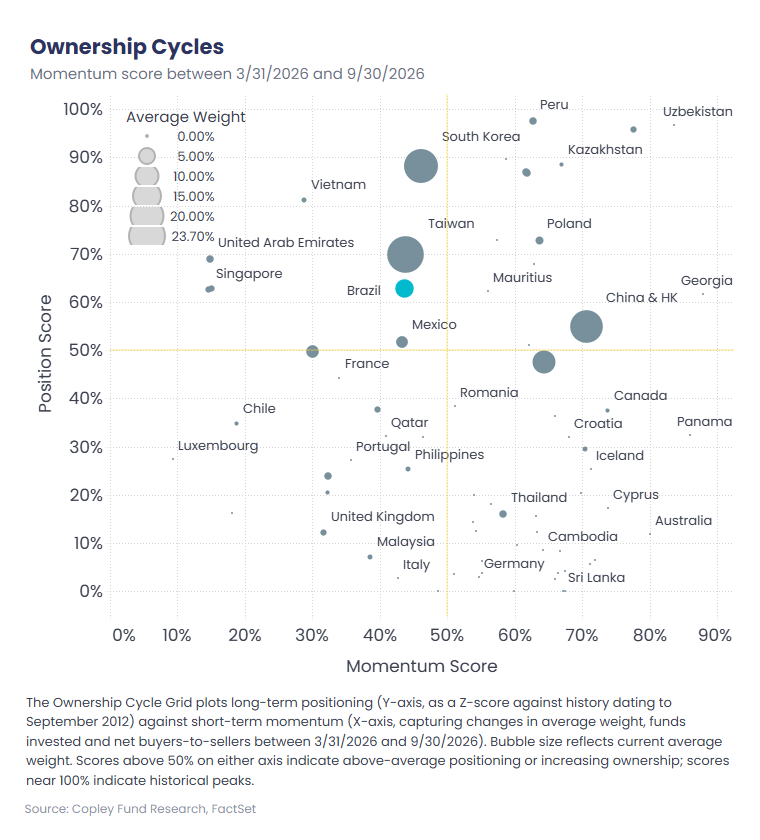
Ownership Cycle Grid
Well owned, momentum cooling
The Ownership Cycle Grid puts Brazil’s positioning in context. It sits above the midline on long-term positioning, at roughly 63% of its historical range, reflecting the depth of the overweight. Short-term momentum is just below the middle of the pack, as the semiconductor rally pulled flows and weights towards Korea and Taiwan.
Brazil went into the vote as a well-owned market with momentum cooling slightly. Managers were not exiting; they were holding conviction while rotating within the market.
The bottom line
A crowded overweight meets a surprise result
Active GEM managers went into Brazil’s election with the market as their highest-conviction country bet. Brazil was the largest overweight in our universe at 1.78%, held overweight by nearly three-quarters of funds, with a record $42.4bn invested. The fall in weight over the six months was the semiconductor rally at work, not selling: buyers matched sellers and net flows were close to zero.
As with any market, managers had been repositioning. Financials remained the anchor, but Energy, Materials and Utilities were gaining investors, Nu Holdings, Embraer and Vale were attracting fresh money, and consumer staples and Petrobras preferred were being sold. That conviction is distinctly active: High Active funds hold double the passive weight, and value managers lead the overweight.
Lula’s victory, and the 13.9% fall in the Ibovespa that followed, now puts that positioning to the test. Brazil’s weight will fall mechanically in our October data. The flows in the following months will show the real decision: whether managers cut, or treat the sell-off as a cheaper entry into one of EM’s highest-conviction markets.
Go deeper
Brazil Market Intelligence Report
The full 50-page report behind this piece covers macro, fund, sector and stock positioning, fund rotation, investor targeting and gap analysis for Brazil, with history back to 2008.