UK Consumer Discretionary Positioning: A Consensus Overweight

UK Equity Funds

UK Consumer Discretionary Positioning: A Consensus Overweight

December 18th 2025

Executive Summary

UK Consumer Discretionary has emerged as a standout conviction trade among active UK equity funds. While average sector weights have remained stable over the past decade, the FTSE All Share benchmark has steadily de-rated the sector—driving a record active overweight of +4.28%. This positioning is not only elevated but also widely held, with 85% of managers overweight, making Discretionary one of the most consensus overweights heading into 2026.

Peer comparisons reinforce this point: Consumer Discretionary now ranks as the fourth-largest sector allocation, yet tops the leaderboard in terms of relative overweight versus benchmark. At the stock level, ownership runs deep, with key names like Whitbread, Compass, and Next widely held. Recent trends show rising interest in names such as Wickes, Carnival, and Trainline, while others like Taylor Wimpey and Dowlais are seeing ownership momentum reverse.

Click on the Report Link below for access to the latest UK Consumer Discretionary Market Intelligence Report.

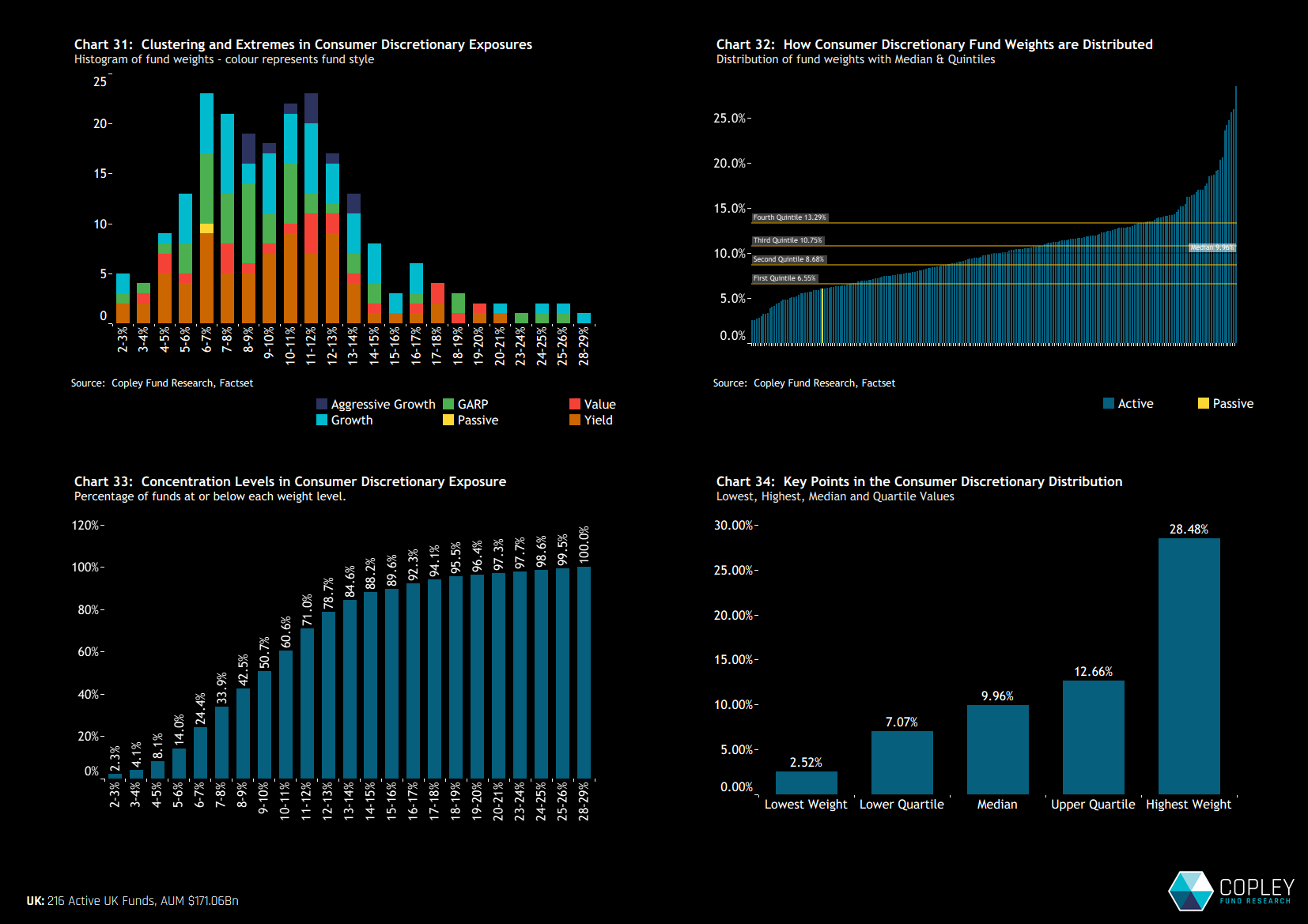
The distribution of fund weights further underscores the sector’s strategic importance. Most allocations cluster between 6% and 13%, and only a small minority—just 15% of funds—sit below benchmark, highlighting how rare a bearish stance on the sector has become.

UK Consumer Discretionary Evolution:  Breaking from the Benchmark
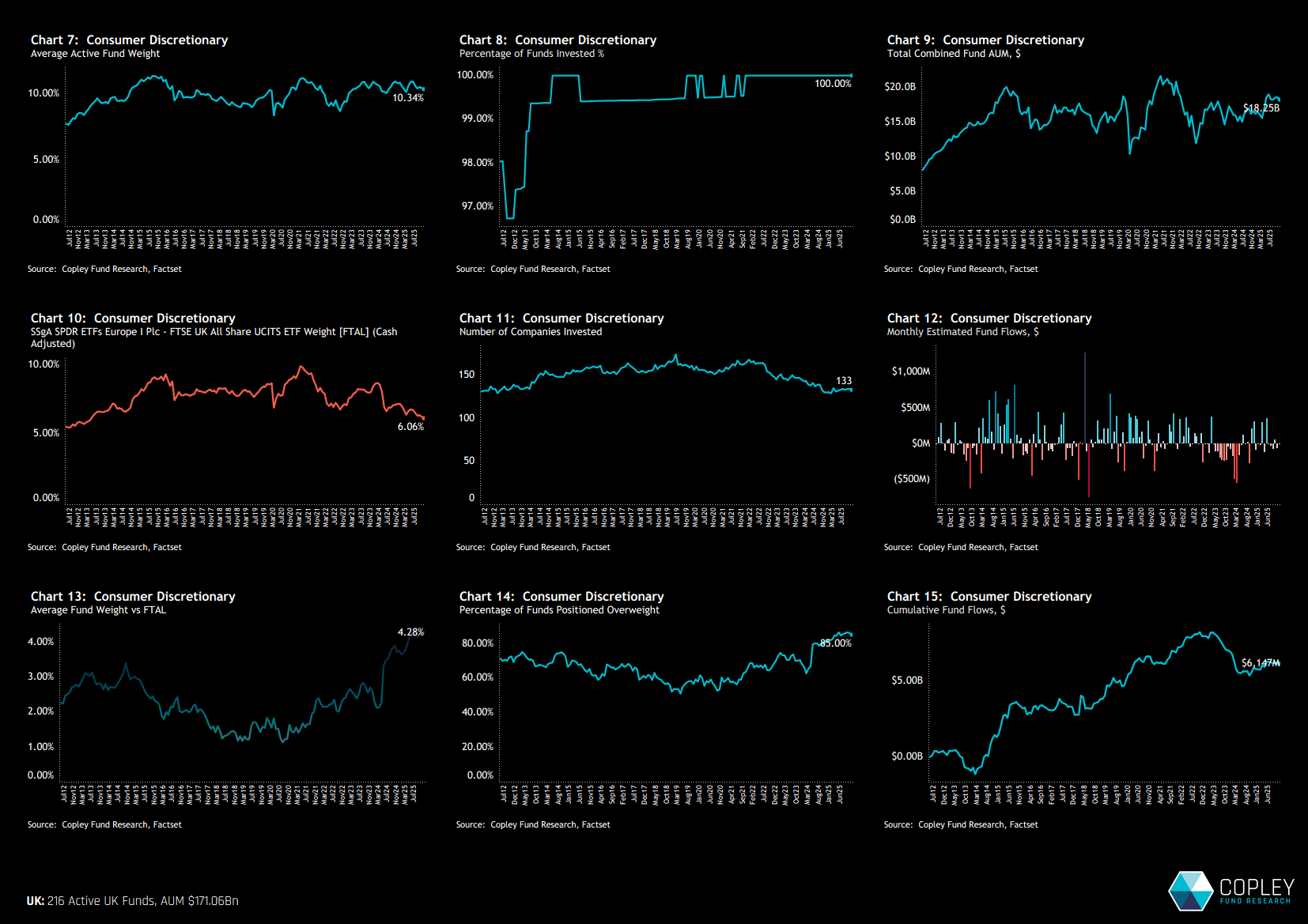
Allocations to Consumer Discretionary stocks have remained remarkably stable over the past decade, with the average fund weight currently at 10.34%—well within a tight 10-year range of 9% to 11% (chart 7). However, this apparent stability masks a sharp divergence from the benchmark: the FTSE All Share’s Discretionary weighting has declined to decade lows (chart 10), resulting in a record active overweight of +4.28% (chart 13). This elevated relative positioning is near unanimous, with 85% of active managers holding an overweight—highlighting a clear consensus in favour of the sector (chart 14).

Peer Positioning:  THE Conviction Overweight
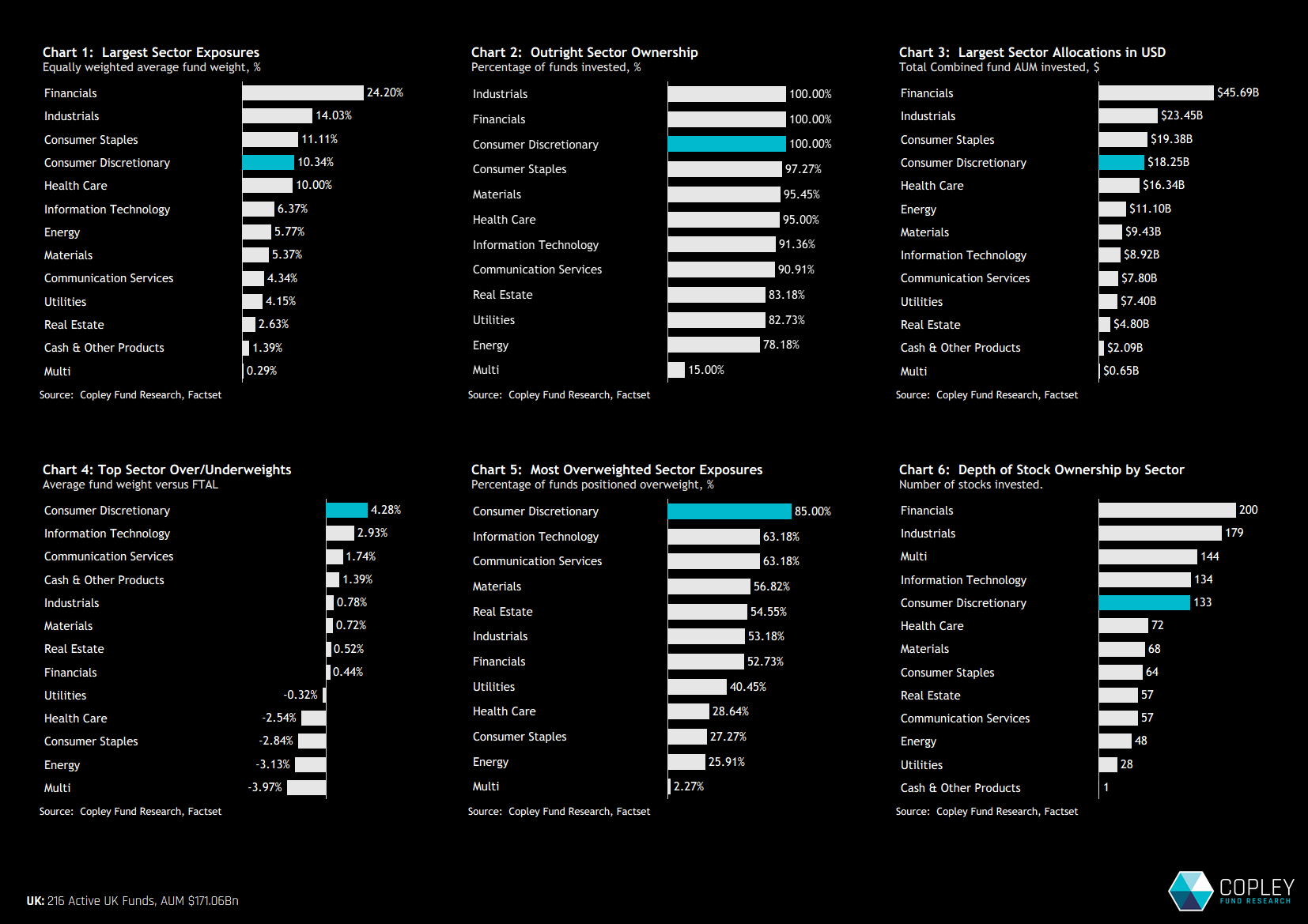
Consumer Discretionary currently ranks as the fourth-largest sector allocation among UK active funds—trailing only Financials, and sitting on par with exposures to Health Care and Consumer Staples (chart 1). However, what truly distinguishes it is not the size of the allocation, but the scale of the active overweight. Among all sectors, Consumer Discretionary stands out as the most pronounced conviction play, surpassing even Technology and Industrials in relative positioning. These overweight bets are key in offsetting structural underweights elsewhere, particularly in Multi-Sector products (notably investment trusts), as well as in Energy and Consumer Staples (charts 4 & 5).

Stock-Level Positioning
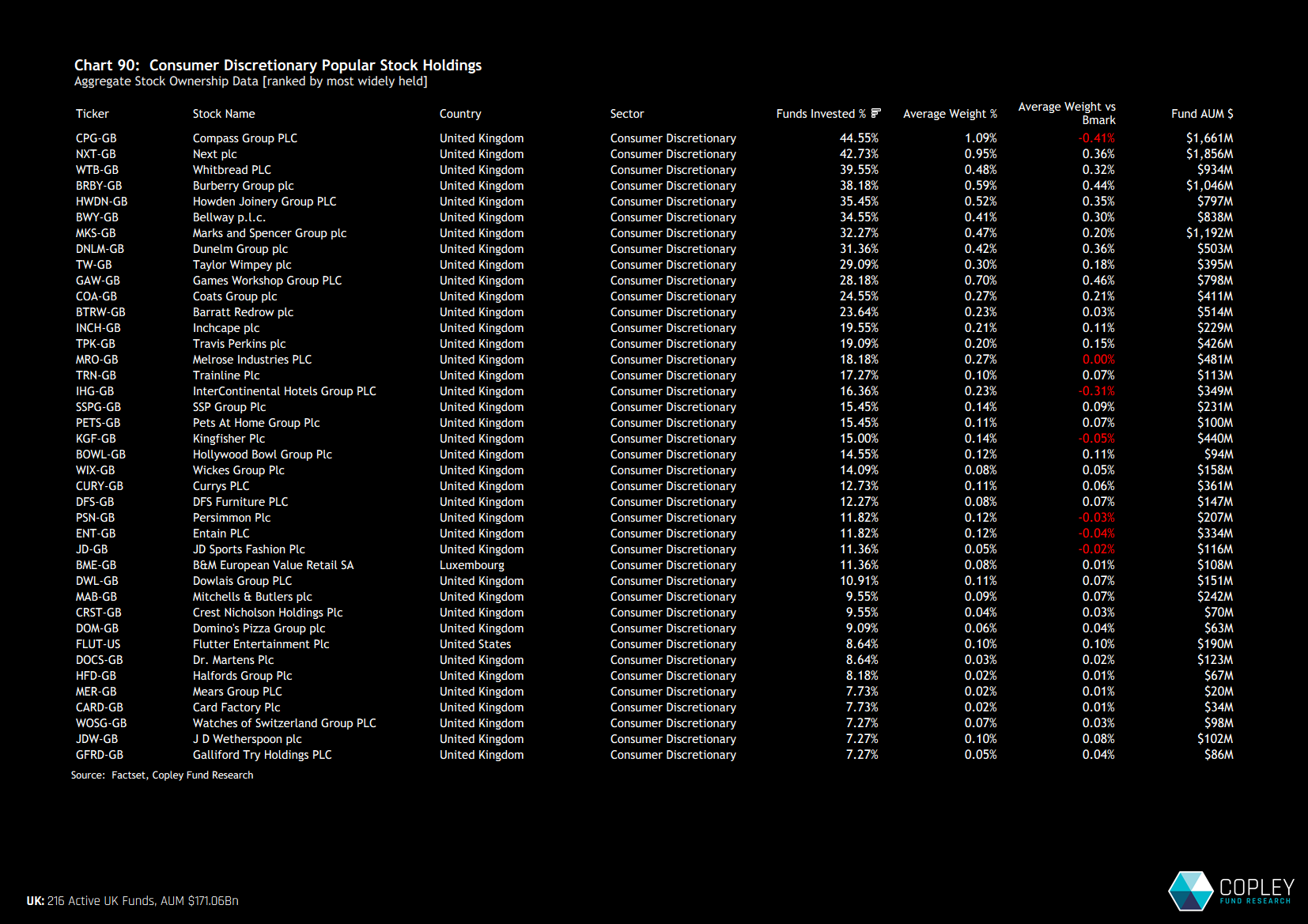
Ownership within the Consumer Discretionary sector runs deep, with eight companies held by more than 30% of UK active managers, led by Compass Group, Next plc, and Whitbread. Despite Compass Group’s broad ownership, its average active weight sits -0.41% below its FTSE All Share index weight. However, solid overweights in Games Workshop, Burberry Group, and Dunelm more than offset this deficit.

Stock Level Analysis:  Interesting Trends in Ownership
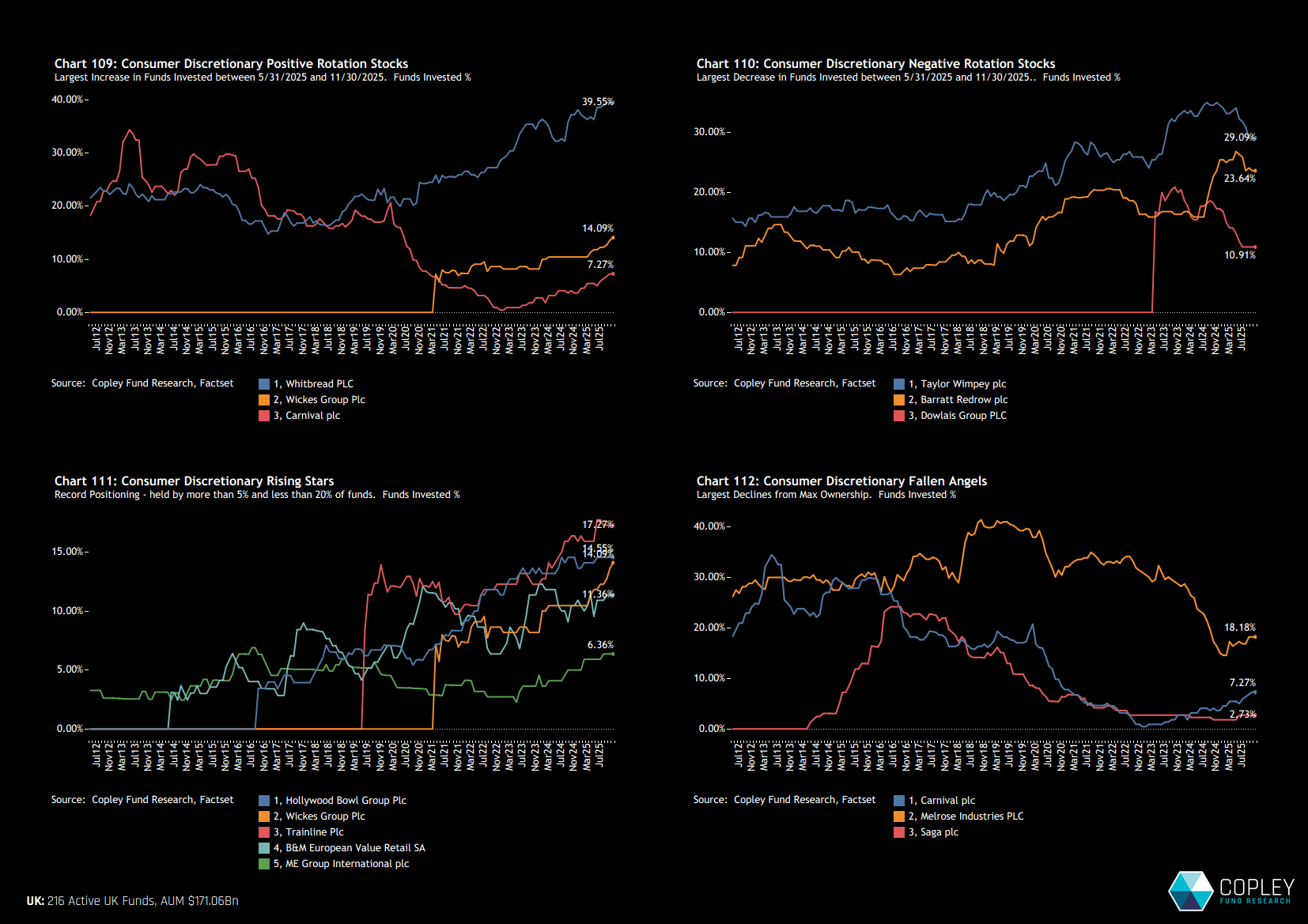
Chart 109 highlights the three stocks with the largest gains in ownership over the past six months, with Whitbread and Wickes Group both reaching all-time highs, and Carnival showing signs of a sustained recovery. In contrast, Chart 110 captures reversals in momentum for Taylor Wimpey, Barratt Developments, Redrow, and Dowlais Group. Chart 111 identifies five ‘rising stars’ in the sector—stocks held by fewer than 20% of UK active funds but currently at peak ownership levels—led by Trainline PLC, Wickes Group, and Hollywood Bowl.

Fund-Level Positioning
At the fund level, most Consumer Discretionary allocations fall between 6% and 13% (Chart 31), with a moderate tail extending to a high of 28.5%. Only 8% of managers hold a weight of 5% or less (Chart 33), underscoring the sector’s role as a strategic allocation for the majority of UK active funds. With just 15% of managers underweight relative to the benchmark, taking a negative stance on Discretionary remains a clear non-consensus position heading into 2026.

AFI – Market Intelligence Report:  UK Consumer Discretionary

Please click on the link opposite for the full positioning report on the UK Discretionary sector.  It contains 133 charts, including fund-level detail at the sector, industry and stock level, breakdowns by Style, Market Cap Focus and Benchmark Independence, together with a full gap analysis on past holders and potential buyers in the sector.