Active GEM Funds: Performance & Attribution Q1 2026
- Steve Holden
- 0 Comments
Global Emerging Markets
Active GEM Funds: Performance & Attribution Q1 2026
April 16th 2026
- March reversal erased early gains: Active GEM funds gave back all 2026 gains in March, leaving returns near flat (+1.34%) and trailing the benchmark, with just 34.5% of funds outperforming.
- “Big Four” divergence drove outcomes: Performance was defined by a sharp split—South Korea and Taiwan contributed strongly while China & HK and India detracted, with country allocation (especially among Aggressive Growth funds) a key driver.
- Stock selection and constraints shaped relative returns: Gains came largely from underweights in China/India names and selective North Asia exposure, while underweight TSMC—driven in part by UCITS limits—was the primary drag, highlighting structural challenges for active managers.
Back to Square One
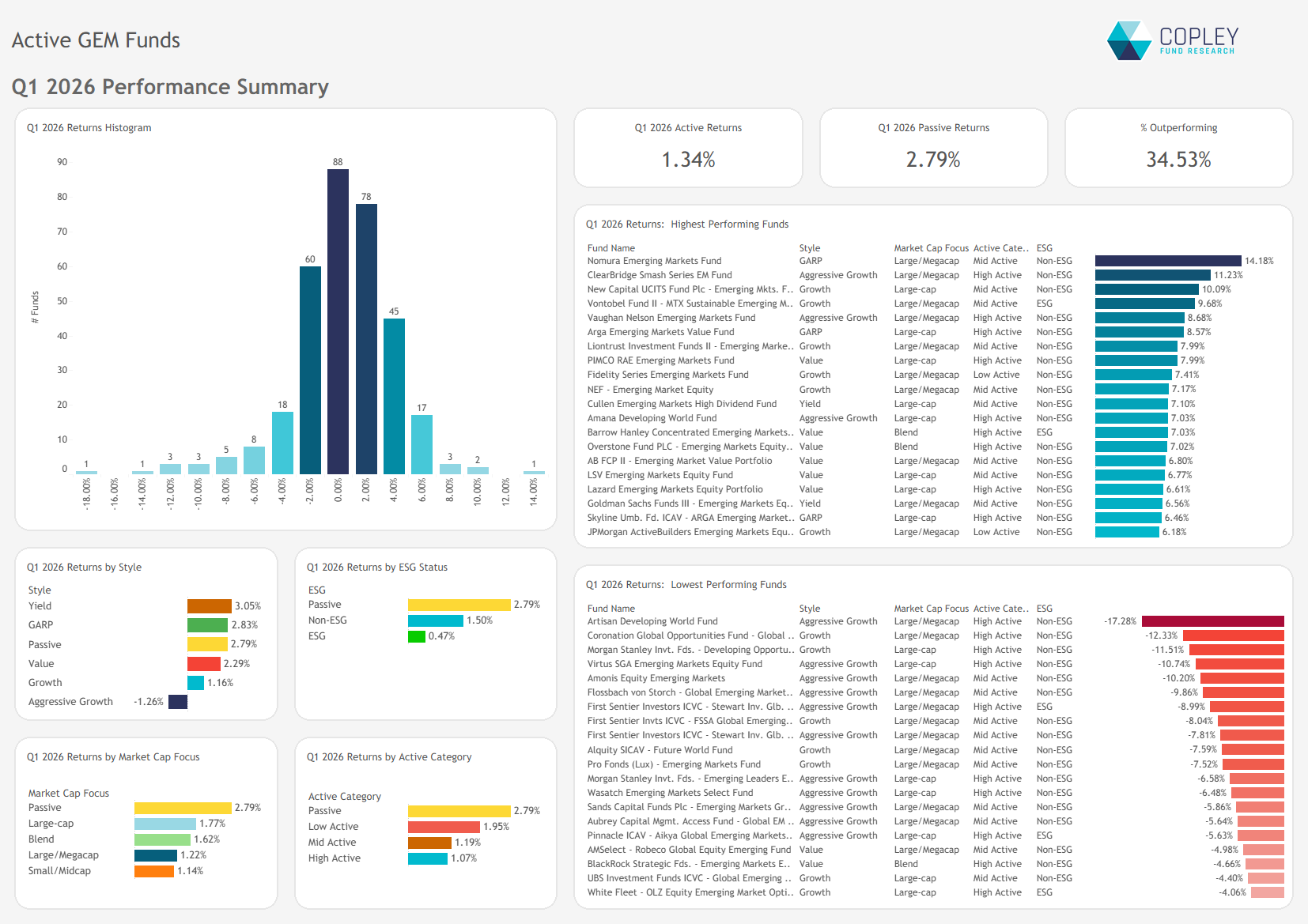
Active GEM funds saw all of their 2026 gains reversed in March. After being up 14.6% at the end of February, a sharp 11.6% decline in March has brought funds back close to flat for the year. Average returns now stand at 1.34%, trailing the iShares MSCI EM ETF by 1.45%, with 34.5% of funds outperforming the benchmark at the end of Q1.
By style, Yield strategies lead the pack, delivering average returns of 3.05%. In contrast, Value, Growth, and Aggressive Growth strategies have all underperformed the index on average. South Korea–heavy Nomura EM and ClearBridge Smash top the rankings, returning 14.2% and 11.2%, respectively.
The Big Four Split
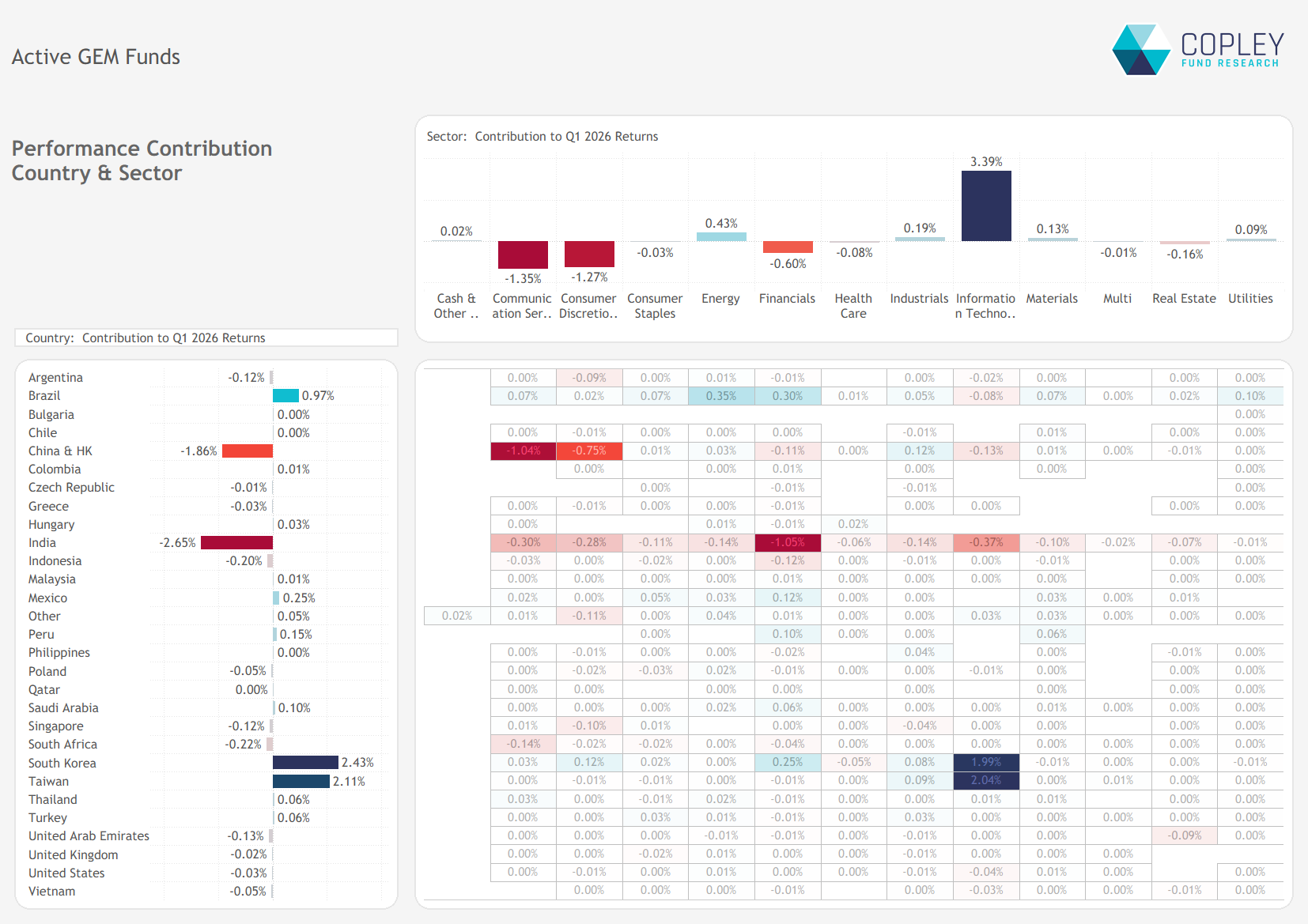
The charts below break down the drivers of Q1 returns by country and sector, based on a portfolio constructed from managers’ aggregate holdings. At the sector level, Technology was by far the largest contributor, adding 3.4% to returns. This was partially offset by Communication Services and Consumer Discretionary, which detracted 1.35% and 1.27%, respectively.
From a country perspective, the divergence across EM’s “Big Four” stands out as the defining trend. South Korea and Taiwan contributed a combined 4.5% to total returns, while India and China & HK detracted an equal 4.5%. Beyond this split, Brazil was the only other meaningful driver, with strength in energy and financials supporting outperformance.
Big Four Split Defines Returns
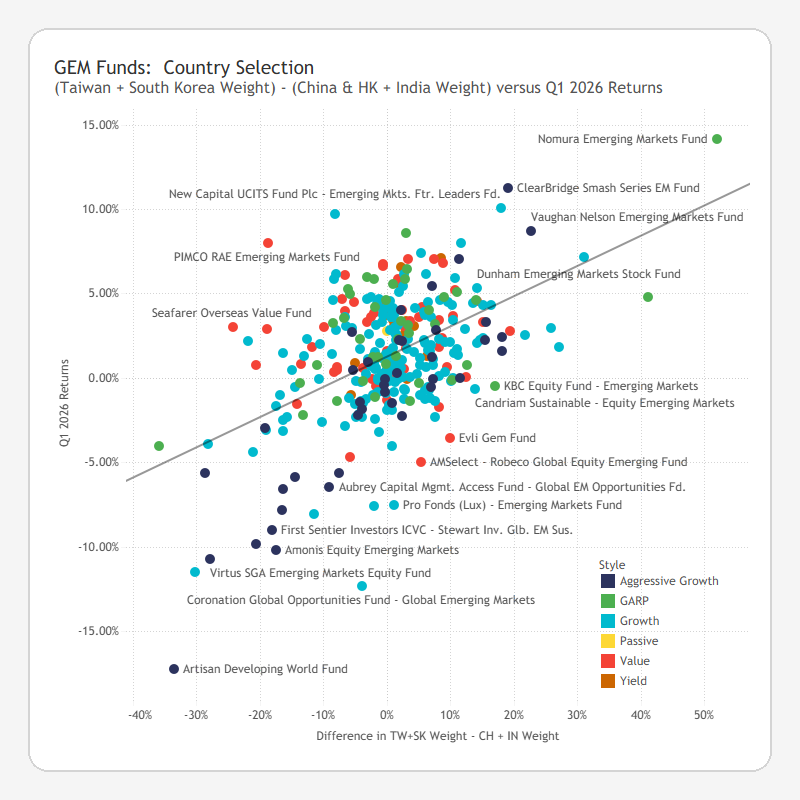
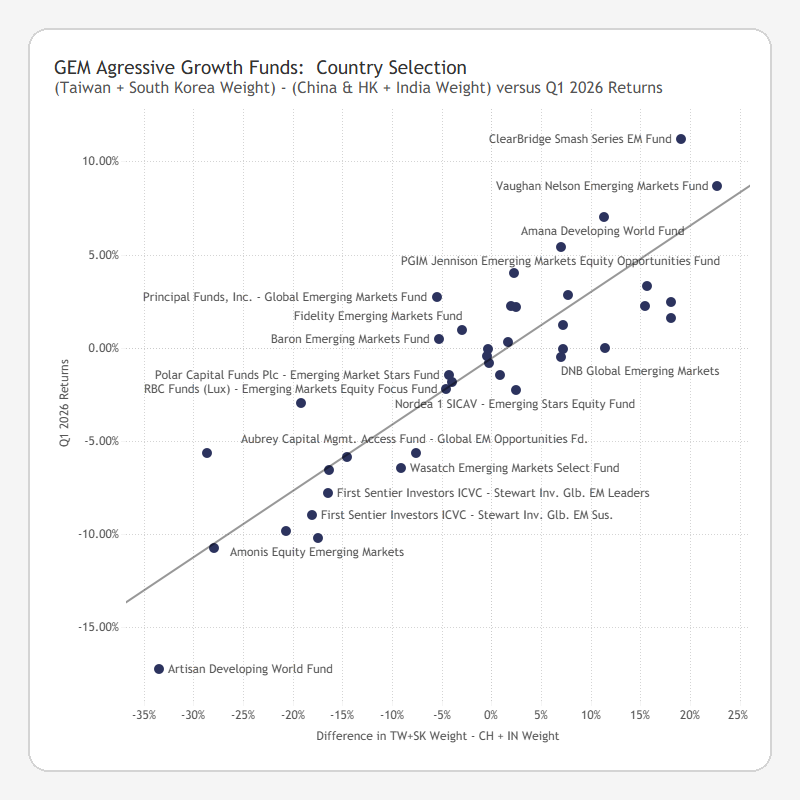
The charts below plot Q1 returns (y-axis) against the net portfolio weight difference between Taiwan and South Korea versus China & Hong Kong and India (x-axis). In other words, the measure reflects the combined weight in Taiwan and South Korea minus the combined weight in China, Hong Kong, and India. The left-hand chart shows all strategies, while the right focuses on Aggressive Growth funds.
Two key observations stand out. First, most data points cluster close to zero on the x-axis, indicating that portfolios are generally balanced between these two regional groupings. Second, there is a clear positive relationship between positioning and returns—most pronounced among Aggressive Growth funds. Here, country allocation appears to have been a primary driver of performance during the quarter, significantly more so than for Value and GARP strategies.
Stock Level Influence
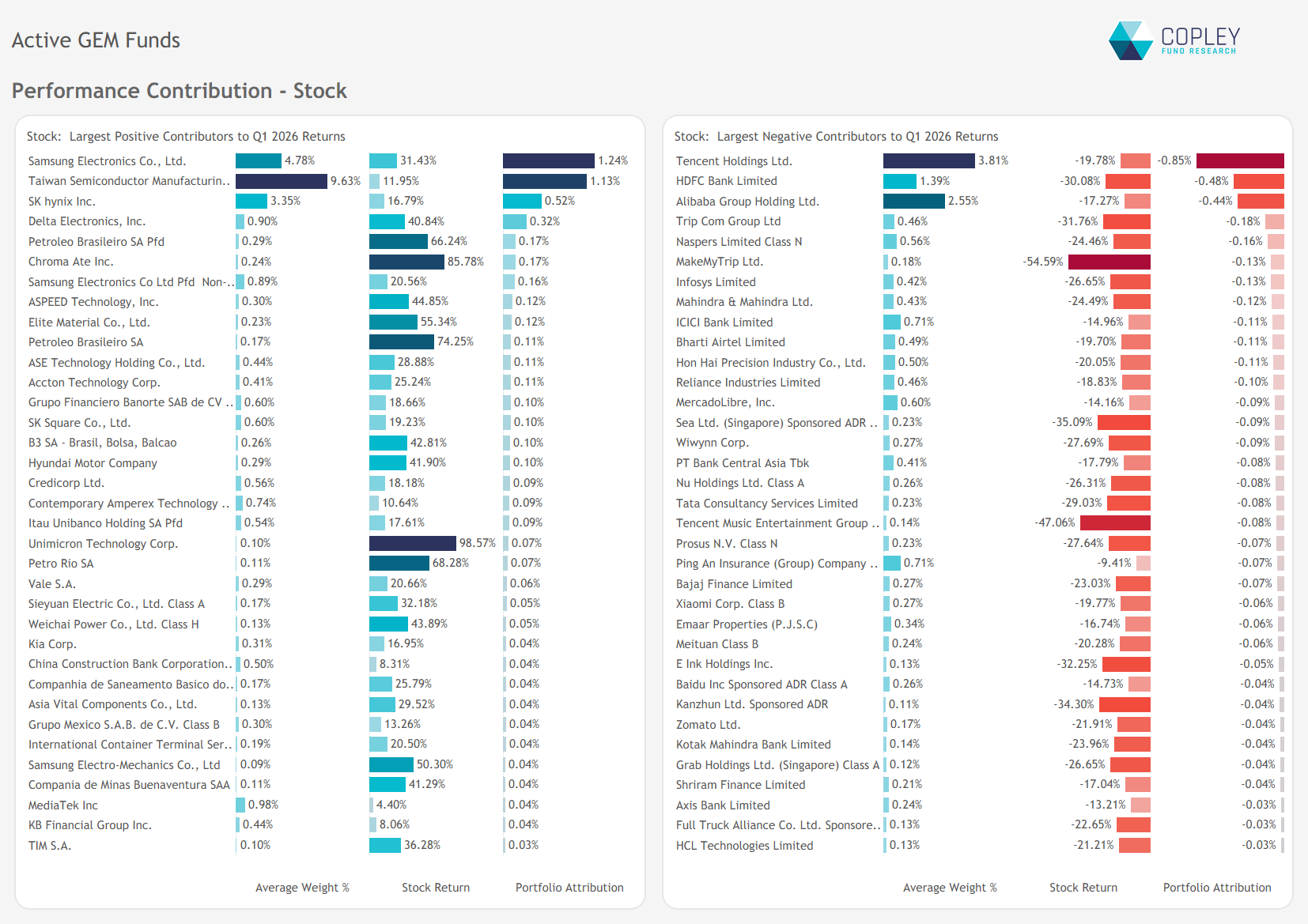
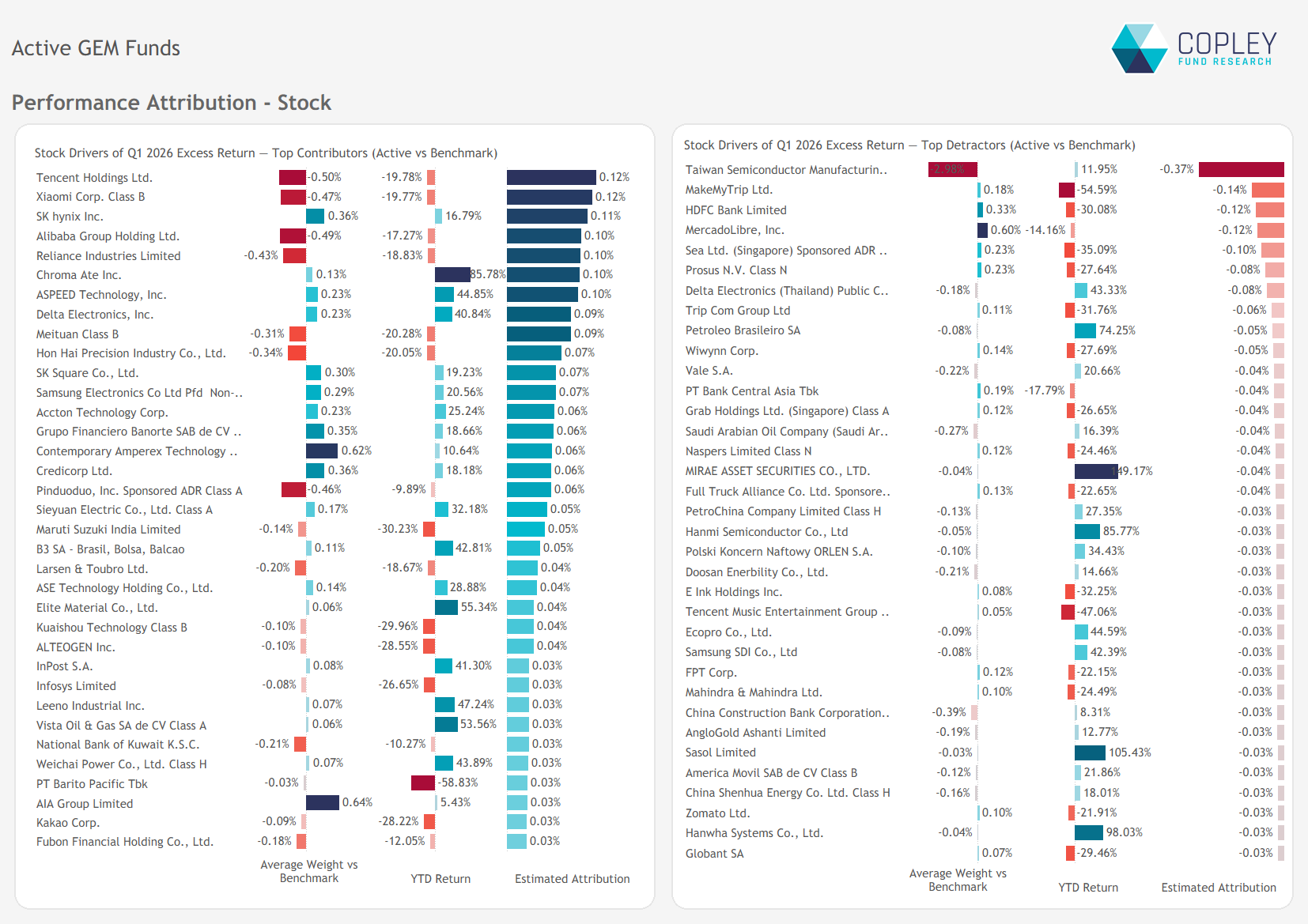
This country-level divergence is clearly reflected at the stock level. Key North Asia holdings—Samsung Electronics, TSMC, SK Hynix, and Delta Electronics—were the primary contributors to returns. In contrast, core China and India positions detracted, led by Tencent, HDFC Bank, and Alibaba Group.
Performance Attribution – Where Funds Beat the Benchmark
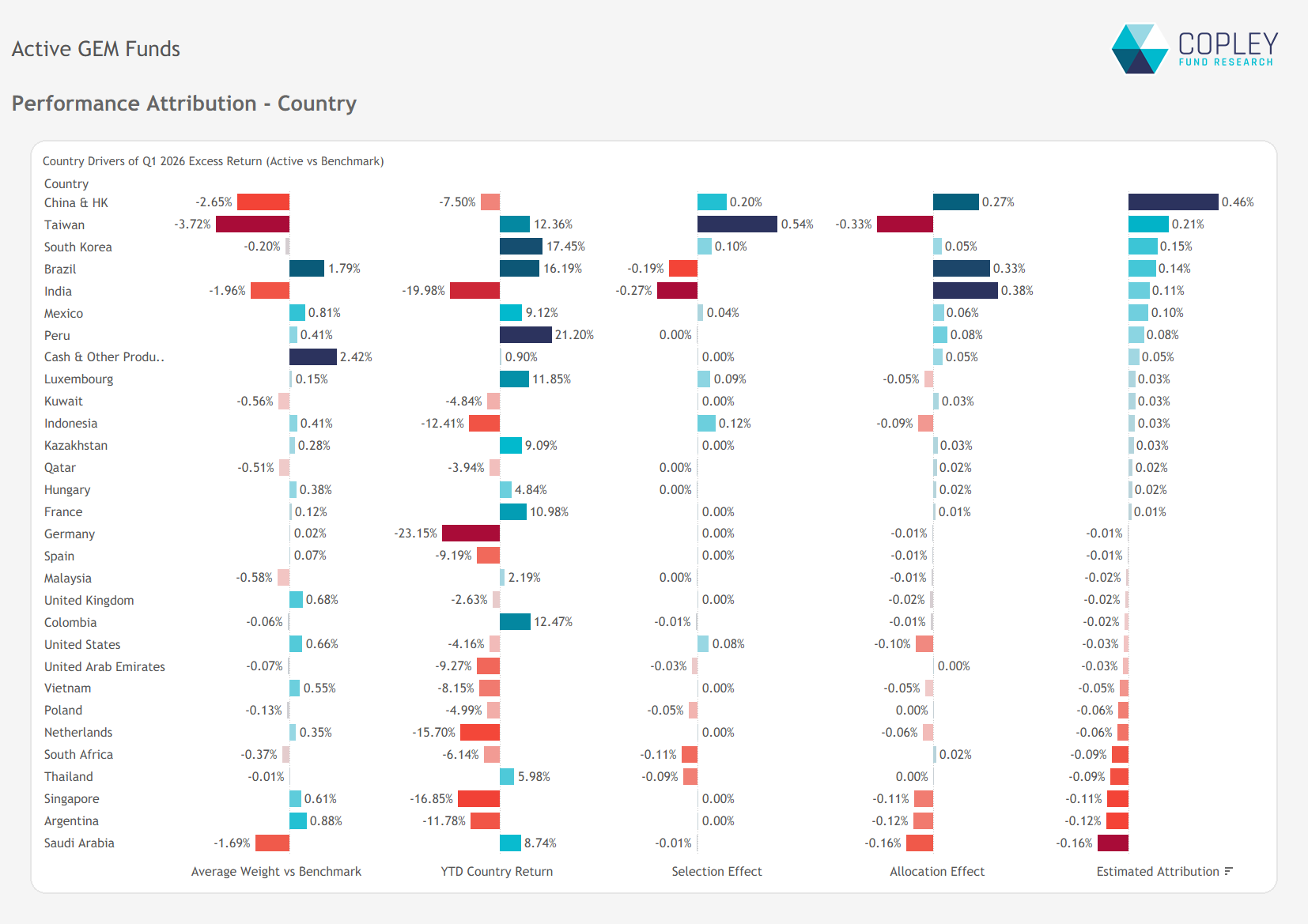
The chart below highlights the main sources of outperformance and underperformance versus the benchmark at the country level. The biggest contributors to outperformance were large underweights in India and China, together with overweights in Brazil and strong stock selection in Taiwan.
On the negative side, returns were held back by underweights in Saudi Arabia and overweights in Argentina and Singapore.
Stock Attribution
Active EM managers benefited from net overweights in SK Hynix, but more meaningfully from underweight positions in Tencent, Xiaomi, and Alibaba Group, which supported relative performance.
On the negative side, a significant underweight in TSMC was the primary drag, highlighting the constraints posed by UCITS mandates that limit single-position weights above 10%. In addition, overweights in MakeMyTrip, HDFC Bank, and MercadoLibre detracted from relative returns.
Long-Term Performance
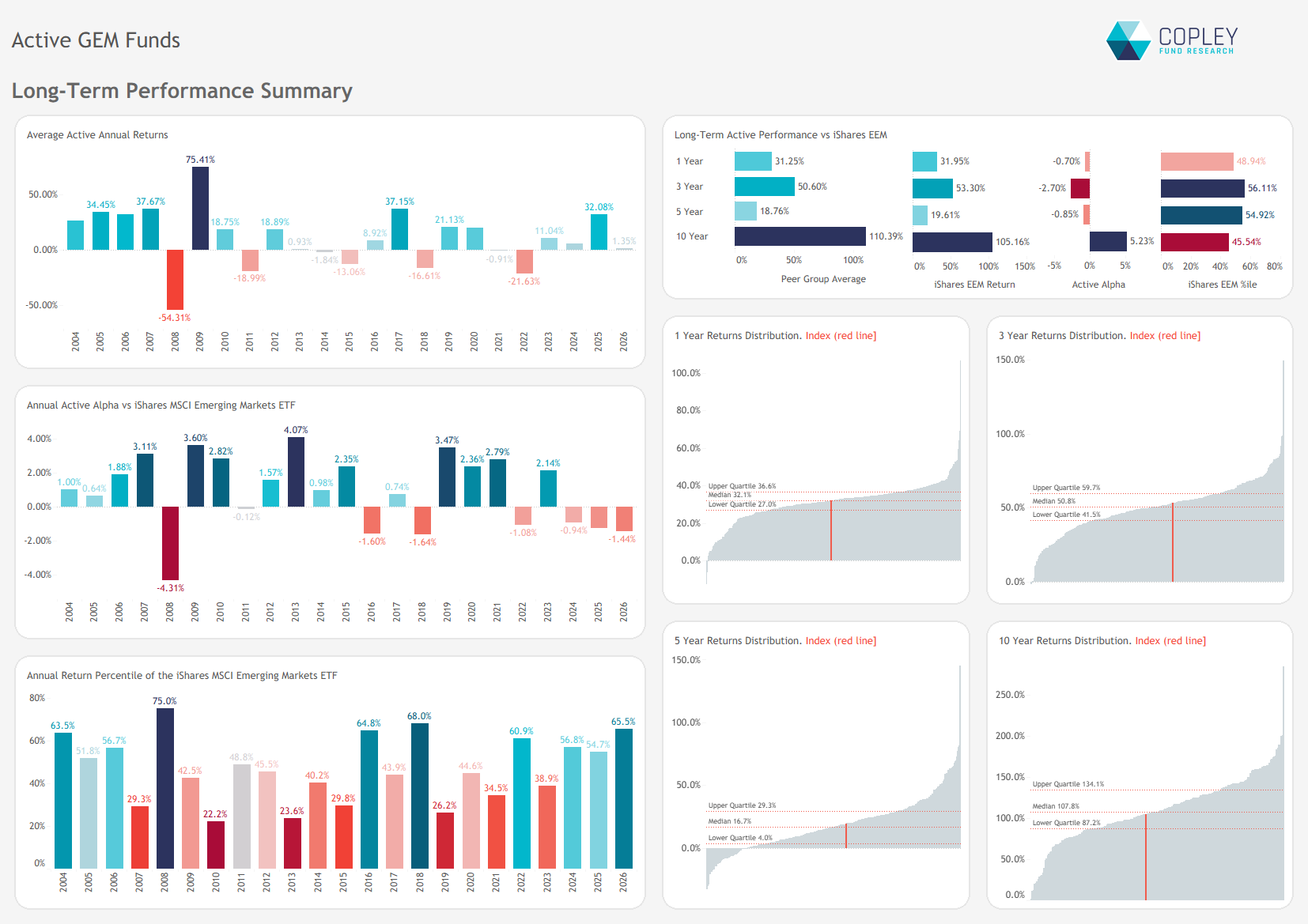
This year’s underperformance versus the benchmark adds to the shortfalls seen in 2024 and 2025. While the longer-term picture still points to a history of active outperformance, EM managers need to reassert themselves as consistent majority outperformers.
The iShares MSCI EM ETF currently sits in the 65th percentile of the active universe year-to-date, edging into more uncomfortable territory as it approaches the top third of funds.
Related Posts
- Steve Holden
- July 20, 2023
GEM Fund Positioning Analysis, July 2023
376 emerging market Funds, AUM $408bn GEM Fund Positioning Analysis, July 2023 In this issue: H ..
- Steve Holden
- April 28, 2026
China Industrials: Bullish Positioning Strengthens Further
China allocations have recovered from the lows, but momentum has stalled—masking active shift ..
- Steve Holden
- June 18, 2025
LATAM: The Conviction Overweight in a Benchmark-Driven World
340 emerging market Funds, AUM $420bn Active GEM Funds: Positioning Analysis, June 2025 ..