Active Asia Ex-Japan Funds: Performance & Attribution H1 2026
July 21st 2026
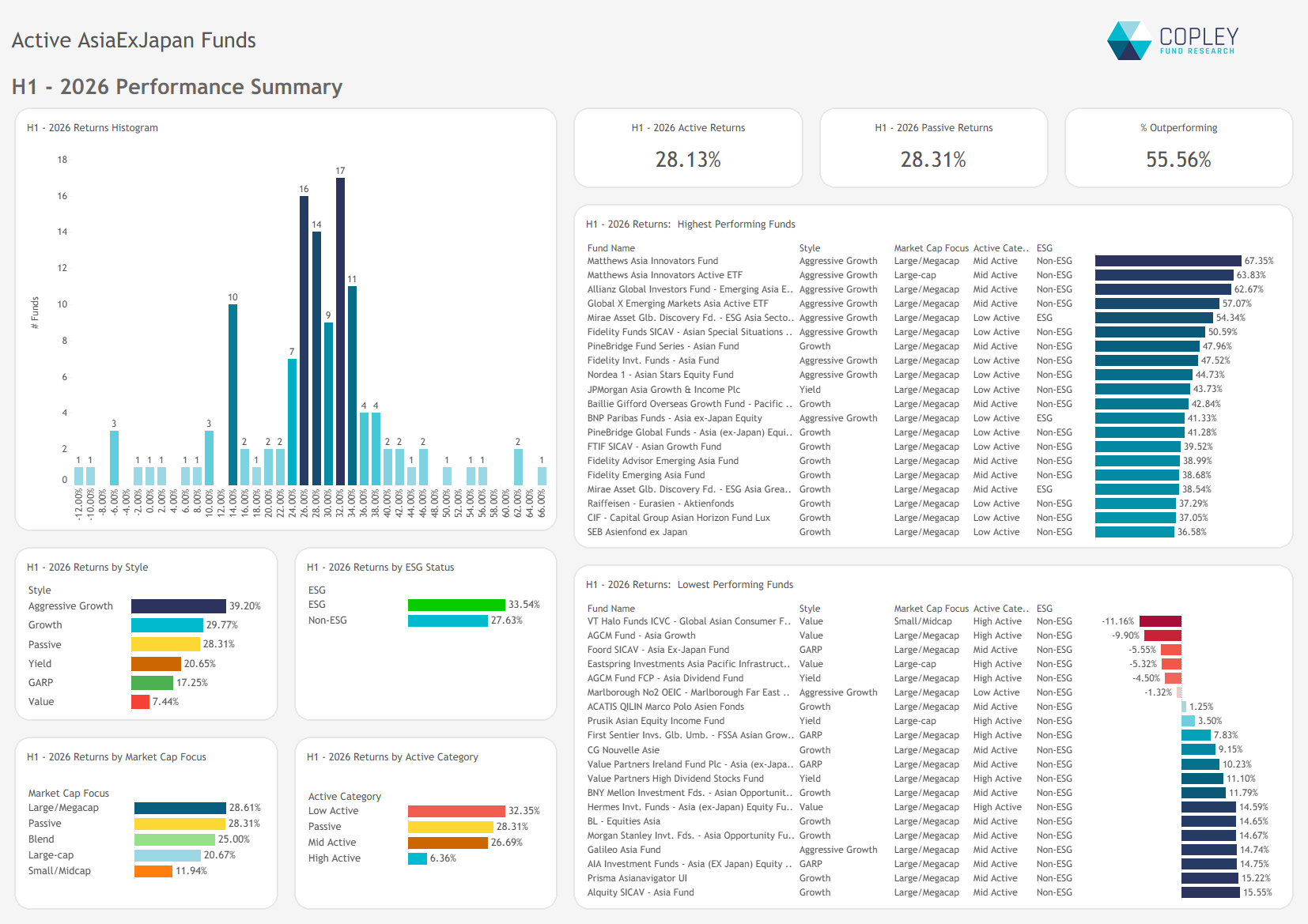
Active Asia ex-Japan funds returned 28.1% in H1, building on 2025’s exceptional gains and cementing the region as one of the world’s strongest-performing equity markets.
Technology dominated returns once again, with Taiwan and South Korea’s semiconductor leaders responsible for the majority of market gains.
A small majority of active managers outperformed the benchmark, supported by South Korean Technology overweights and strong stock selection across the region’s leading Tech names.
Strong Second Quarter Drives First-Half Returns
Active Asia ex-Japan funds returned 28.13% on average during the first half of 2026. After ending Q1 only marginally positive, a strong rally through April and May propelled managers well ahead for the year. Performance tracked closely to the iShares MSCI AC Asia ex Japan ETF, with a slight majority of funds outperforming the benchmark.
The strongest performers were dominated by growth-oriented managers, led by Matthews Asia, Allianz and Global X. Growth and Aggressive Growth were the only investment styles to outperform the benchmark over the period, while the small number of Value managers in our analysis lagged well behind.
Technology Continues to Dominate
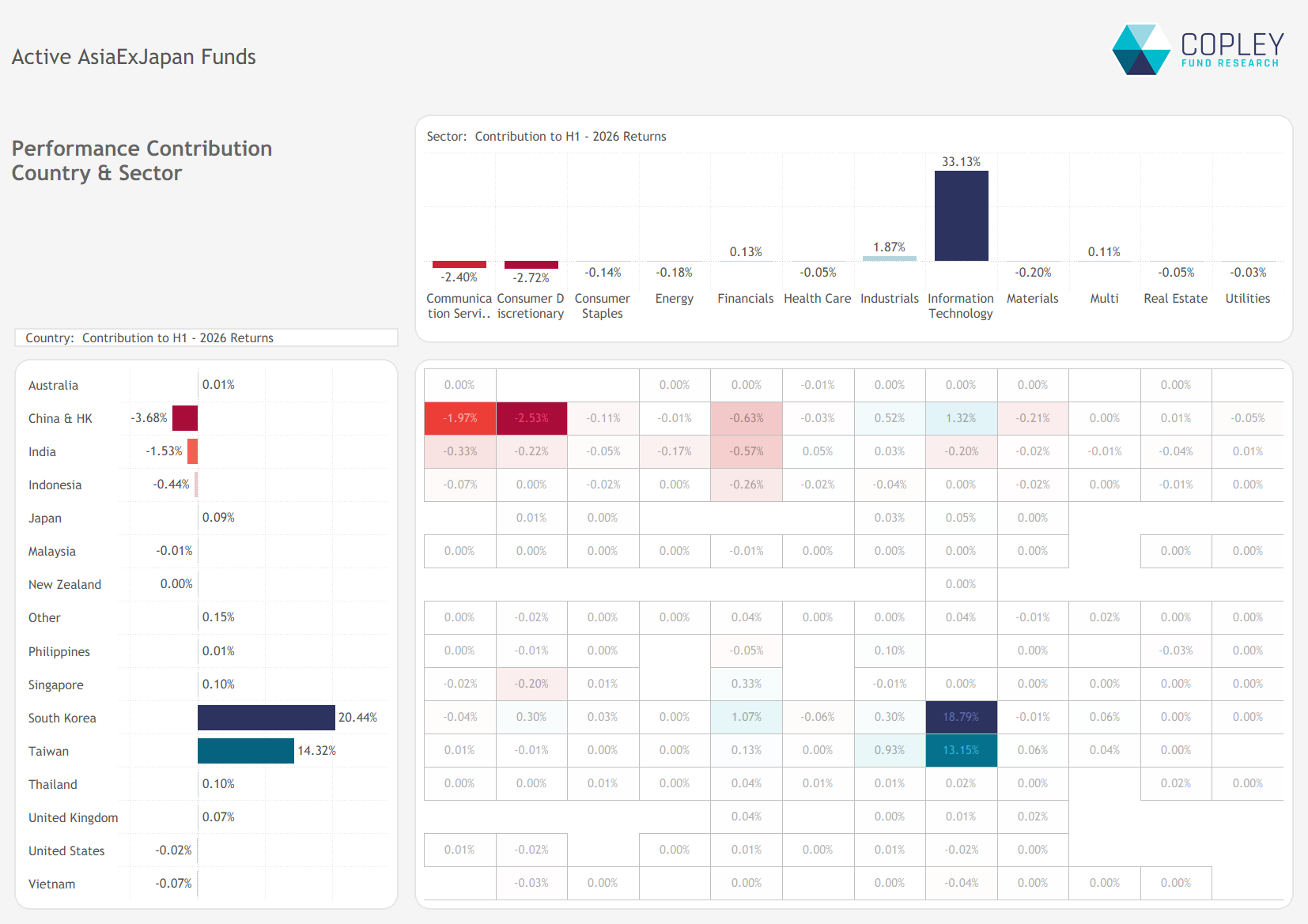
The charts below break down first-half returns by country and sector, based on aggregate manager holdings. At the sector level, Technology once again dominated performance. Its 33.13% return accounted for more than the average fund return, with gains partially offset by losses in Communication Services and Consumer Discretionary.
At the country level, the story was similarly concentrated. Taiwan and South Korea were the only meaningful contributors to absolute returns, reflecting the sector’s heavy reliance on the region’s semiconductor and hardware leaders. Weakness across China’s Communication Services and Consumer Discretionary sectors, together with broad-based losses in India, weighed on overall performance.
Away from the headline contributors, China & Hong Kong Technology, South Korean Financials and Taiwan Industrials also provided support. By contrast, Indonesian Financials, Chinese Materials and Singapore Consumer Discretionary were among the largest detractors during the first half.
Stock-Level Influence
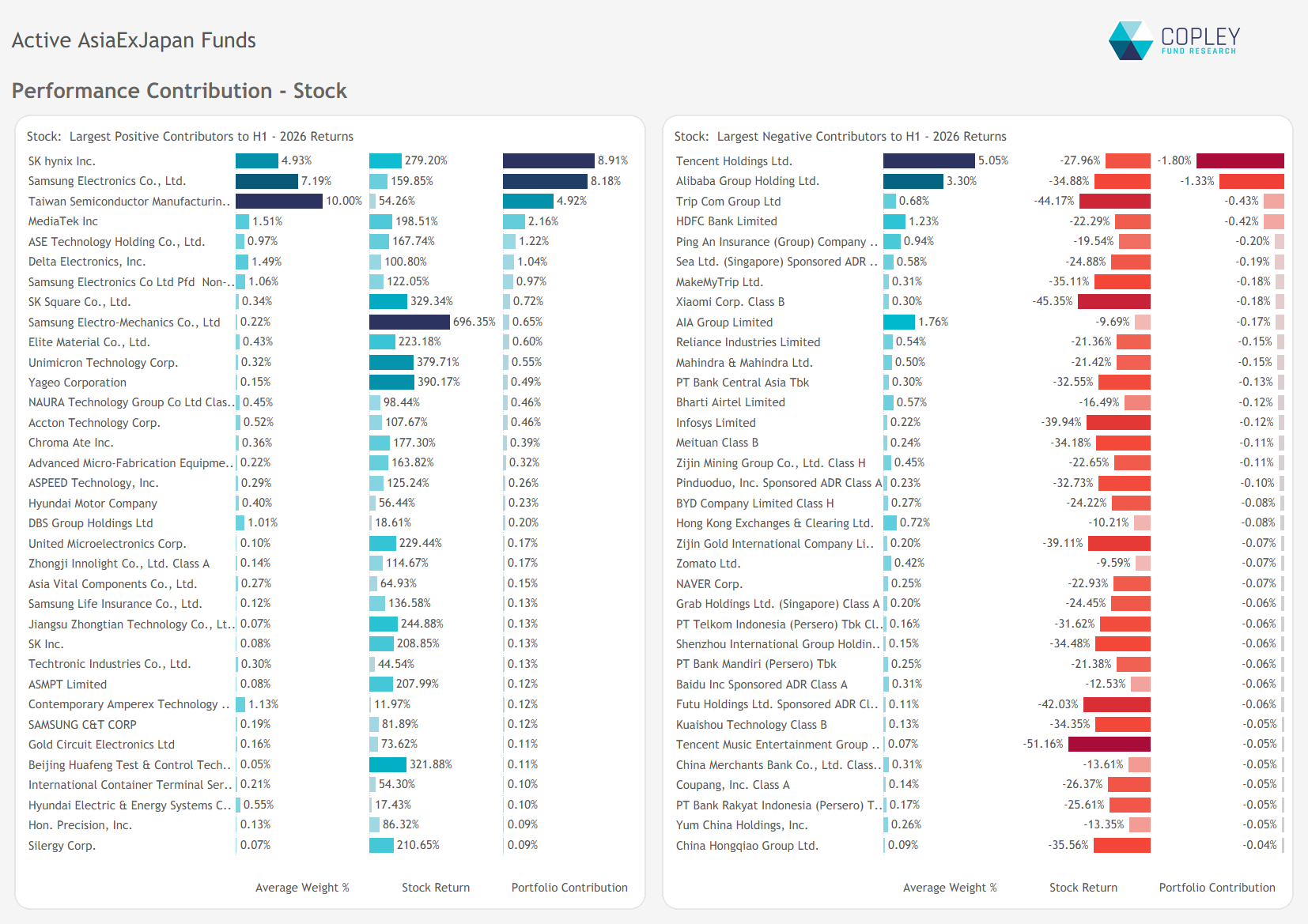
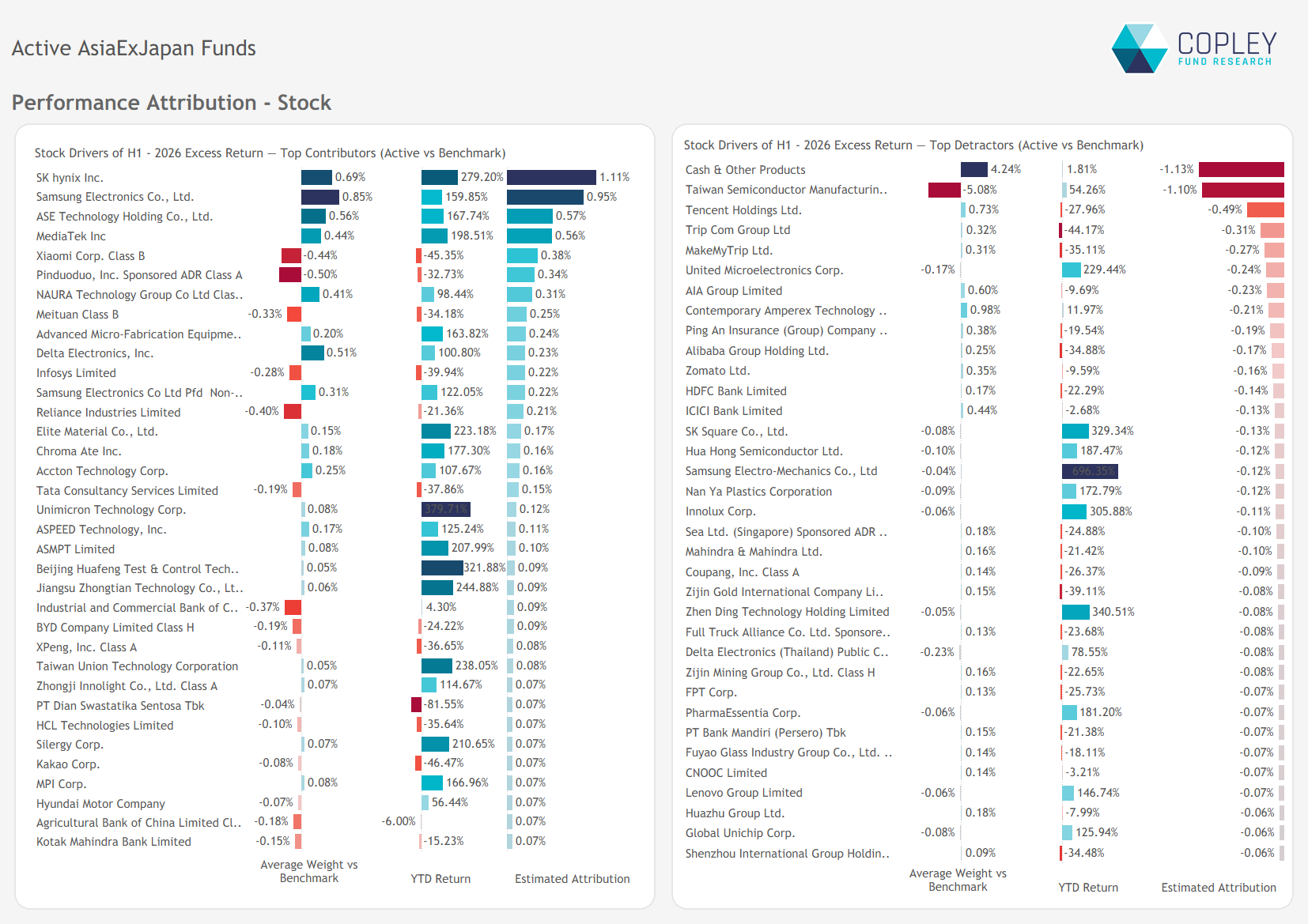
Performance at the stock level was even more concentrated than at the country and sector level. SK Hynix, Samsung Electronics, TSMC and MediaTek were the standout contributors, accounting for more than 25% of average first-half returns between them.
These gains were partially offset by weakness in several core China and India holdings. Tencent, Alibaba Group, Trip.com and HDFC Bank detracted around 4% on average, but the pullback was nowhere near enough to offset the exceptional contribution from Taiwan and South Korea’s technology leaders.
Performance Attribution – Where Managers Added Value
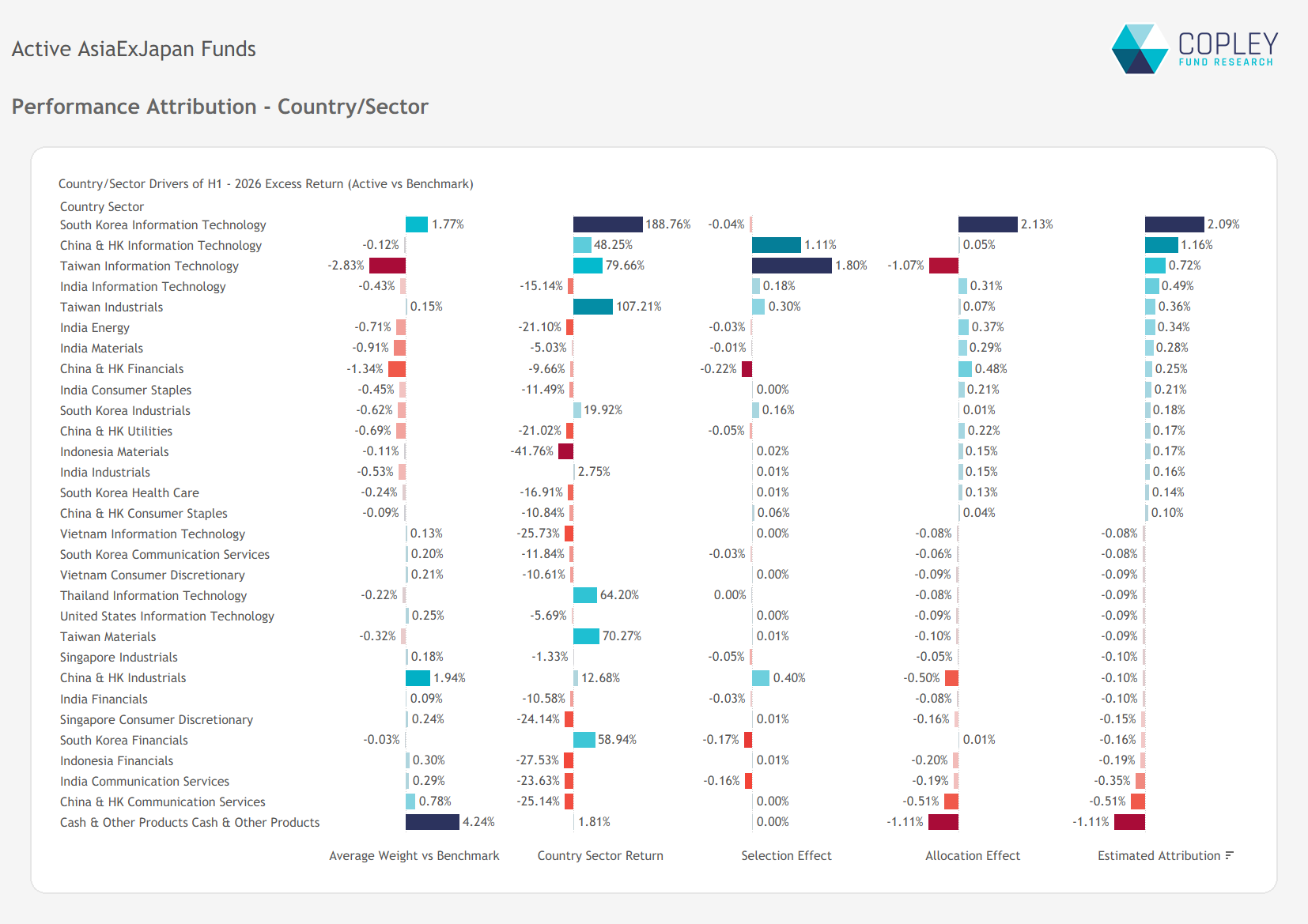
The chart below breaks down the key drivers of relative performance at the country and sector level. Asia ex-Japan managers generated meaningful outperformance through a combination of positioning and stock selection. Overweight exposure to South Korean Technology was the largest positive allocation decision, while stock selection within Taiwan and China & Hong Kong Technology also made a significant contribution to relative returns.
The largest headwind came from cash holdings, reflecting the strength of the underlying market. Overweight positions in China Communication Services and Industrials also detracted from benchmark-relative performance.
Stock Attribution
ctive Asia ex-Japan managers generated much of their outperformance through stock selection within the region’s best-performing technology names. Overweight positions in SK Hynix, Samsung Electronics, ASE Technology and MediaTek all made meaningful positive contributions to benchmark-relative returns.
The biggest headwind came from average cash holdings of 4.24%, which proved costly in a rising market. A sizeable underweight in TSMC also weighed on relative performance, although for many UCITS managers this partly reflected position-size constraints rather than a straightforward negative stock call.
Long-Term Performance
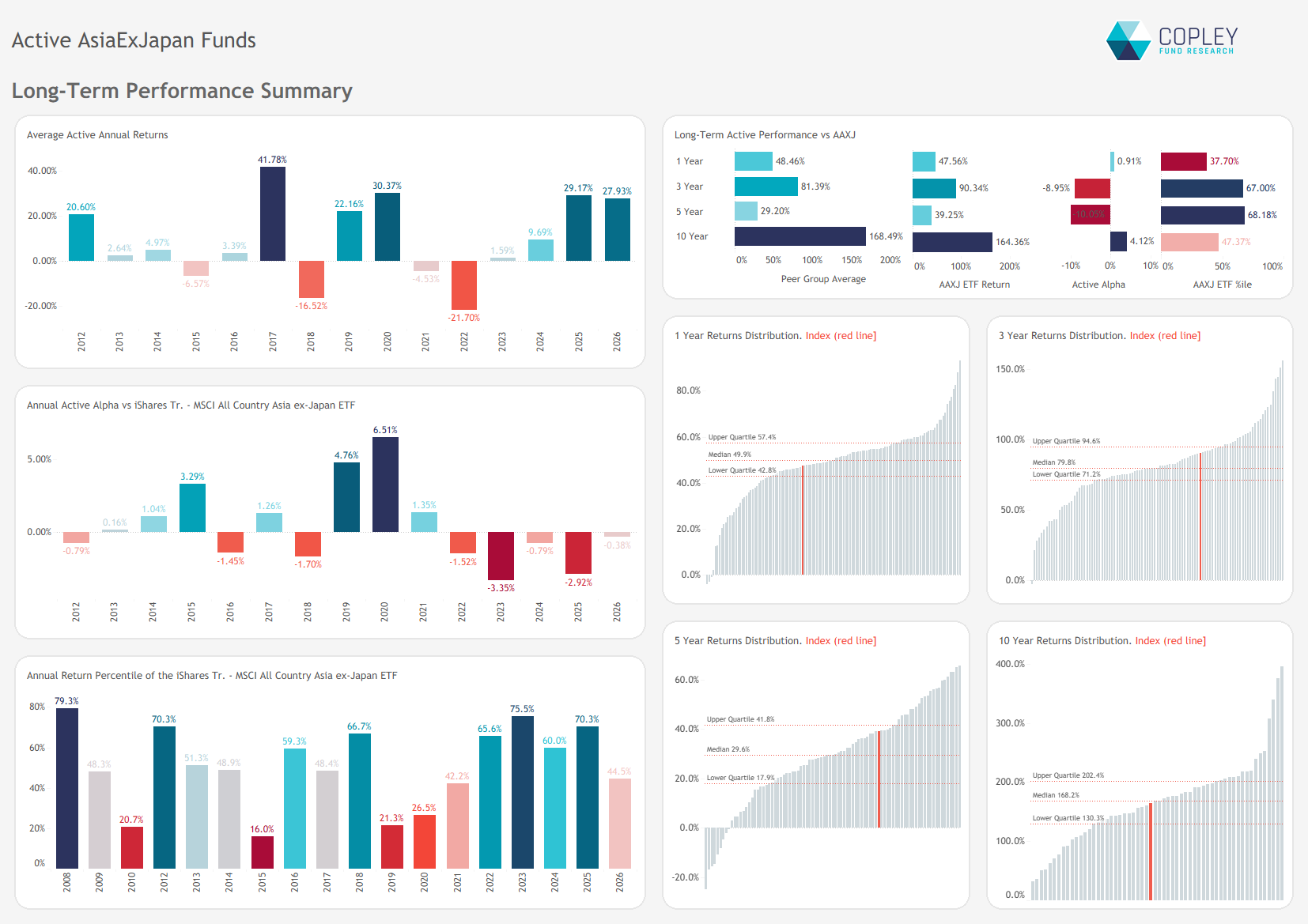
Average active funds have returned 27.9% in the first half of 2026, following a 29.2% gain in 2025. Together, those two years have established Asia ex-Japan as one of the world’s strongest-performing equity markets.
Just as importantly, active managers have reduced the gap versus the benchmark. Having ranked between the 60th and 70th percentile among active peers for much of the past four years, the benchmark has slipped below the median fund in 2026. Long may it continue.
Performance & Attribution Report
Click the link opposite for full charts and data detailing the drivers of H1 2026 performance, along with a review of 3-, 5-, and 10-year results across the active Asia Ex-Japan peer group.