UK Equity
March 31st 2026
Executive Summary
In this analysis, we examine how UK equity fund positioning is distributed across the ownership spectrum — from the most widely held consensus names to the long tail of low-participation stocks.
We track both the number of companies held and how capital is allocated across different ownership buckets, highlighting how portfolios are structured and where conviction is being expressed. This includes analysing the evolution of the most crowded positions, the role of the middle ownership ranges, and the characteristics of the long tail.
We also explore how stocks move through the distribution — identifying entry and exit points across key thresholds, and highlighting cases where position sizes signal stronger conviction despite limited ownership.
How Many Companies Do Active UK Investors Own?
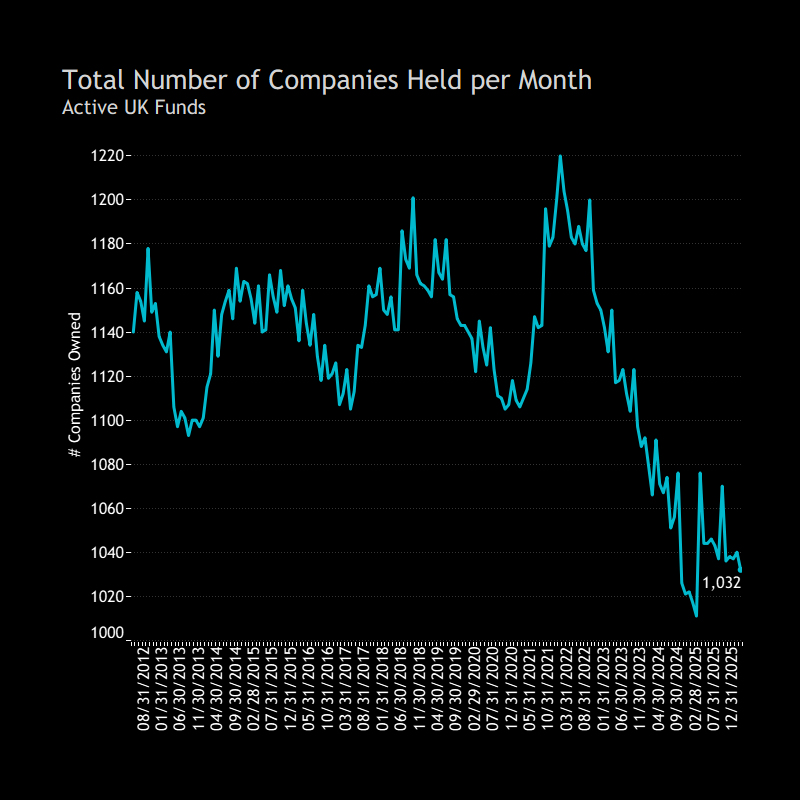
The number of companies held by active UK funds peaked at just over 1,200 in 2021, before trending steadily lower to ~1,030 today. Breadth is clearly contracting, with portfolios becoming more selective over time.
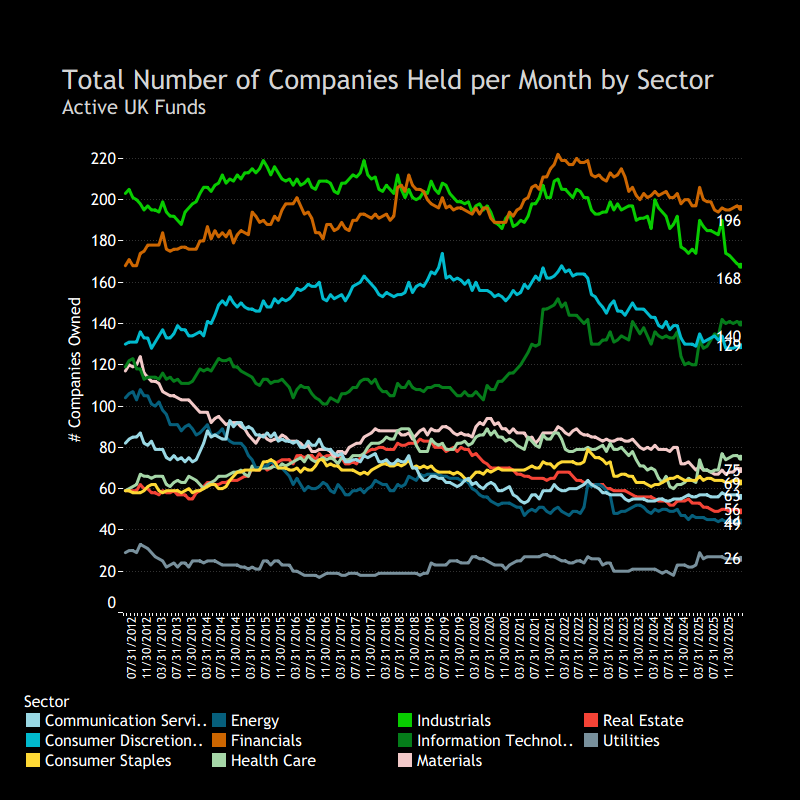
Beneath the surface, positioning remains tilted toward a small group of dominant sectors, with a clear gap between the largest allocations and the long tail of smaller exposures.
Ownership Breadth
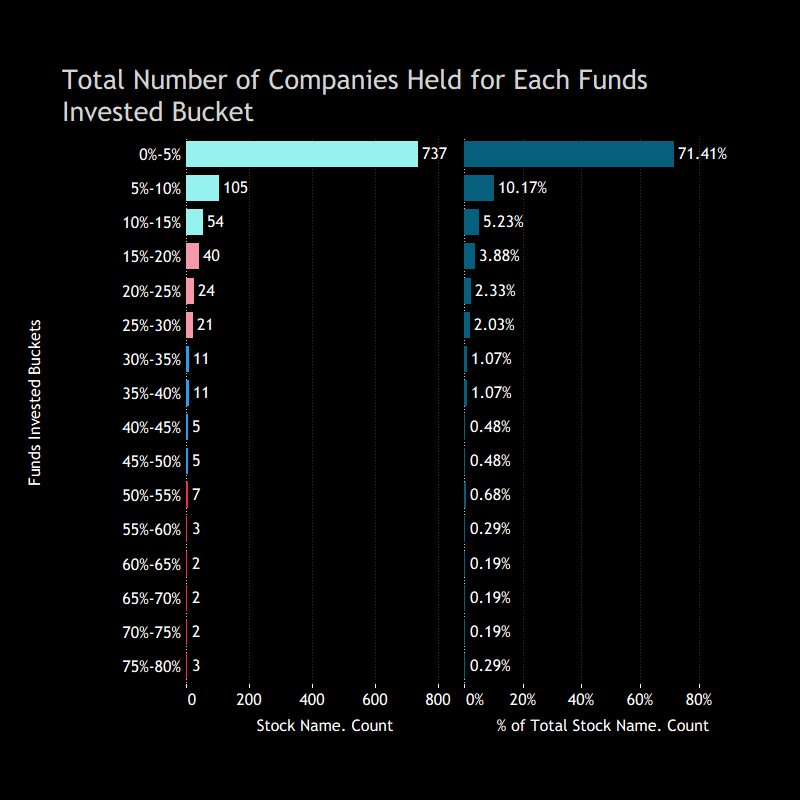
Ownership breadth across UK portfolios is highly skewed. The majority of stocks are held by only a small fraction of funds, with 737 companies owned by fewer than 5% of investors (~71% of the universe). From there, the opportunity set narrows rapidly, with relatively few names achieving broad ownership.
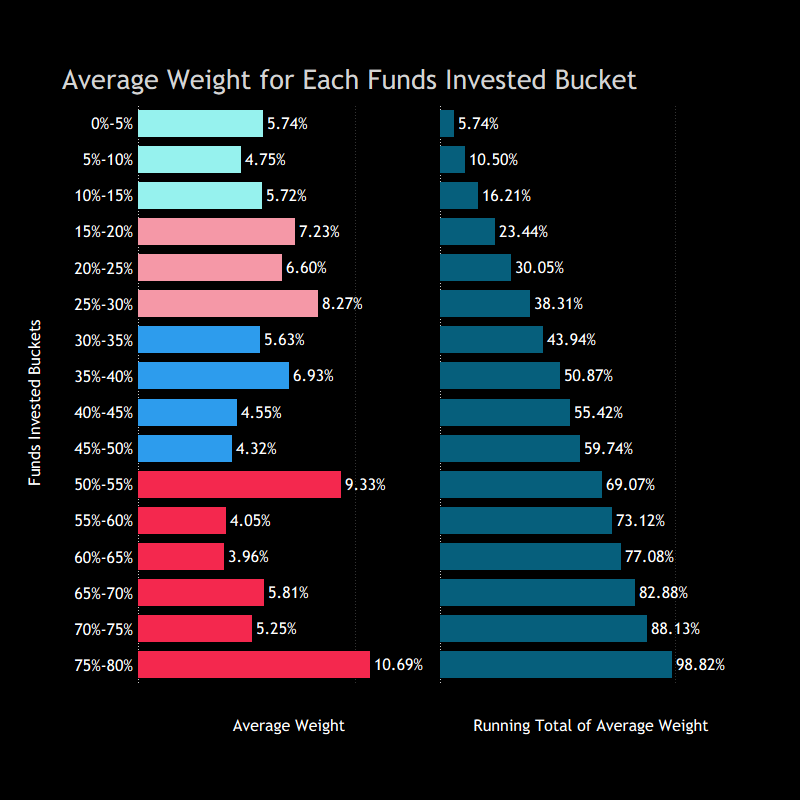
This skew in stock count is less extreme when viewed through portfolio weights. While the long tail of stocks (held by a small minority of funds) dominates in number, it represents a more modest share of capital, reflecting smaller position sizes and more selective conviction. At the top end, ownership becomes much more concentrated. A small group of widely held stocks accounts for a disproportionately large share of capital, with the most crowded names (held by a majority of funds) commanding meaningfully larger weights within portfolios.
Concentration Rising: Shift Toward Consensus
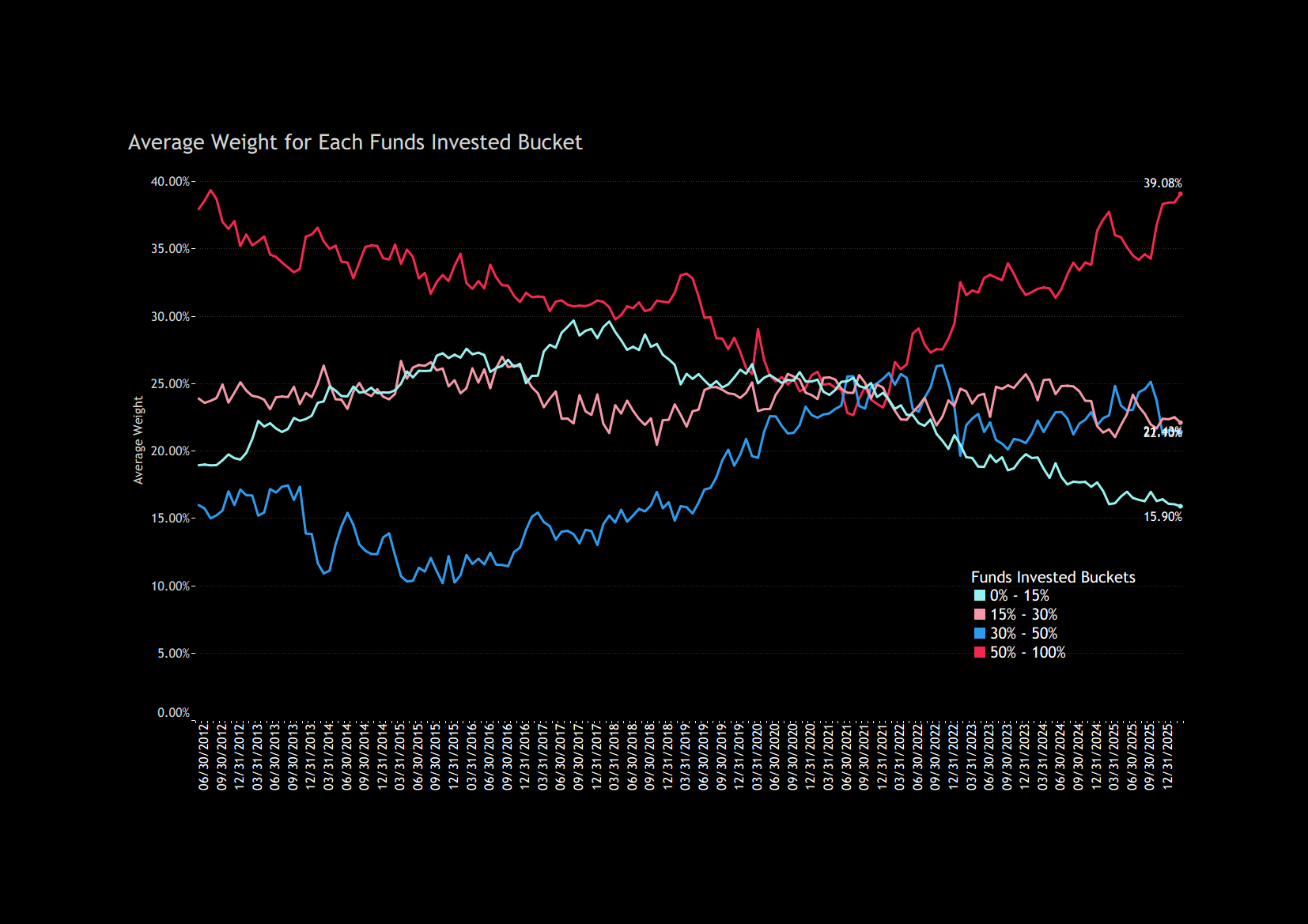
Between 2012 and 2021, capital had been moving away from the most widely held names, with the 50–100% bucket gradually losing share. That dynamic flipped in 2021 (post COVID?) — with weights in the most crowded cohort surging back toward ~40%, reclaiming clear dominance within portfolios.
This has come at the expense of the long tail. The least-owned names (0–15%) have steadily faded in importance, with their share of capital continuing to drift lower, reinforcing the move away from more differentiated positions.
The middle buckets tell a more muted story. While they participated in the earlier broadening of portfolios, they have not seen the same degree of re-acceleration, leaving the recent shift driven primarily by a renewed focus on the most widely owned stocks.
Stocks held by more than 50% of funds
Crowding at the Top: More Names, More Weight
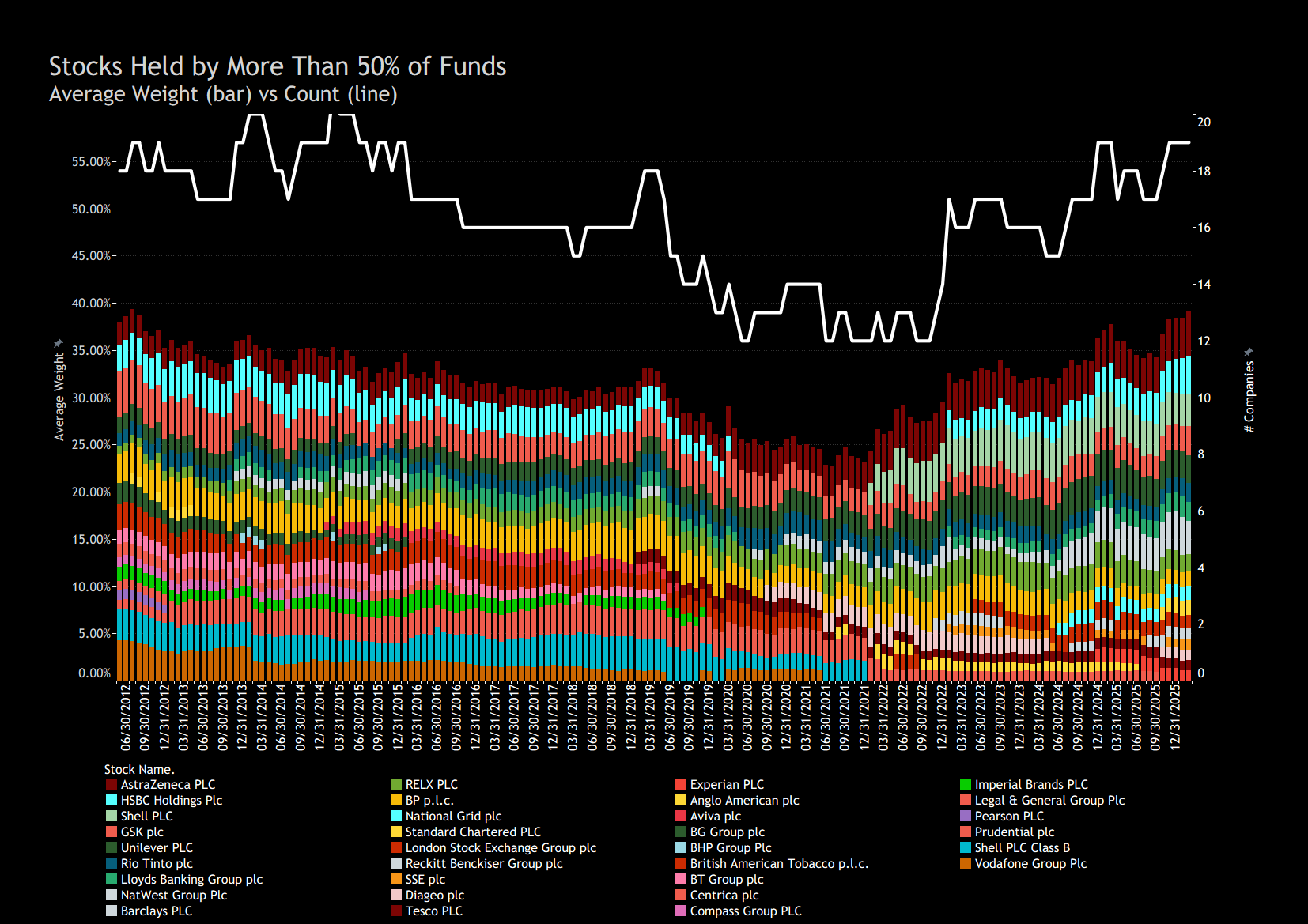
The number of stocks held by more than 50% of UK funds has pushed higher, now sitting close to the top end of the historical range at 19 names. What was once a more limited group of consensus positions has broadened into a larger cohort of widely owned stocks.
At the same time, the capital allocated to these names has rebuilt steadily. After compressing into 2020, weights have climbed back, with the most crowded stocks now accounting for well over a third of portfolios — and continuing to edge higher.
Ownership Trends within the 50% Club
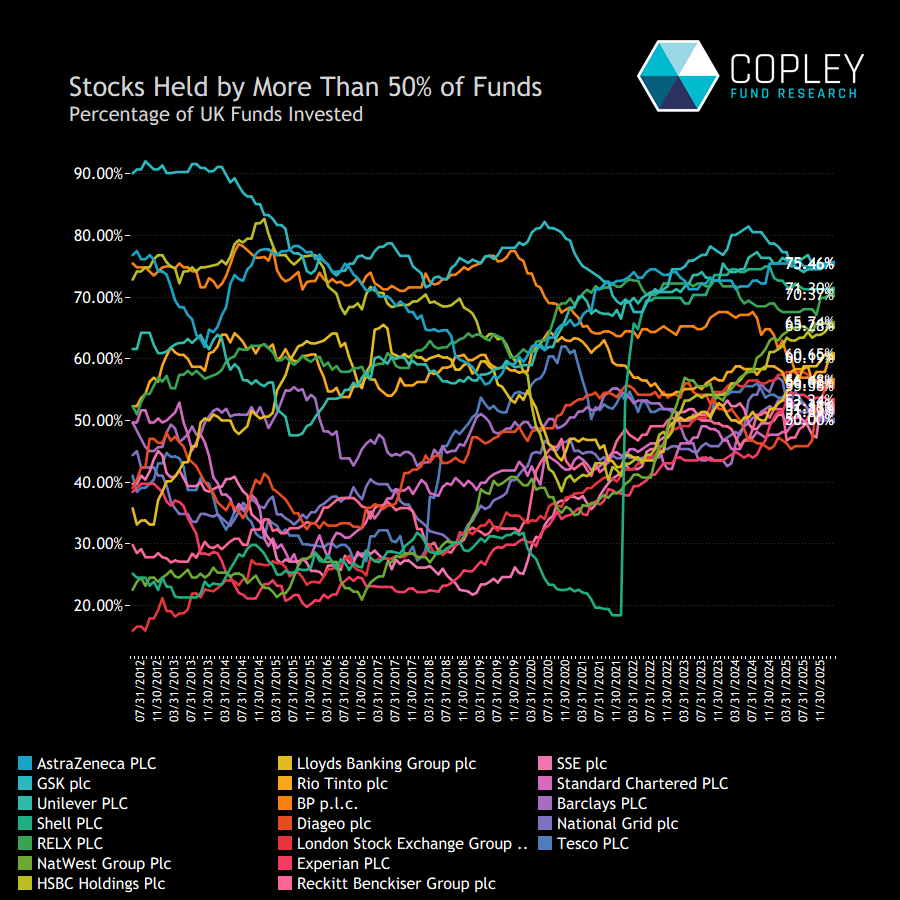
The current >50% cohort has been built relatively recently. While a handful of names have consistently sat in this group, much of today’s cohort has only crossed the threshold over the past few years, pointing to a broadening of consensus rather than a static leadership group.
What stands out is the path into the top tier. Ownership tends to build gradually at first, but once names move through the ~30–40% range, participation often accelerates. From there, several stocks transition quickly into widely held positions, with ownership continuing to climb toward 60–70%+.
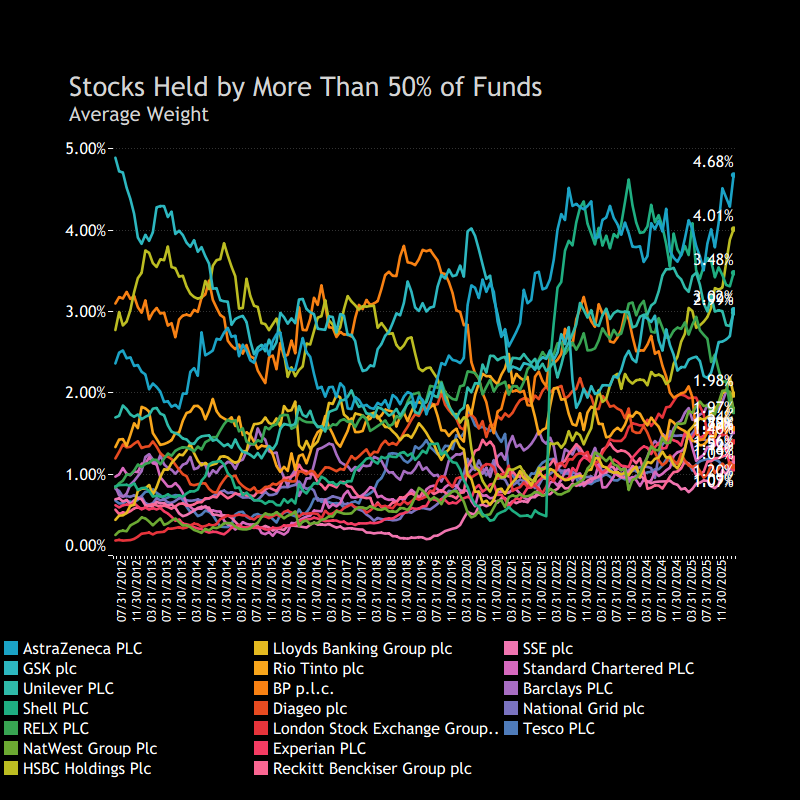
The weight profile is more uneven. While inclusion in the >50% club brings higher capital allocation, the dispersion across names remains wide — with a smaller subset of stocks accounting for a disproportionate share of the cohort’s total weight.
The 30% - 50% Cohort
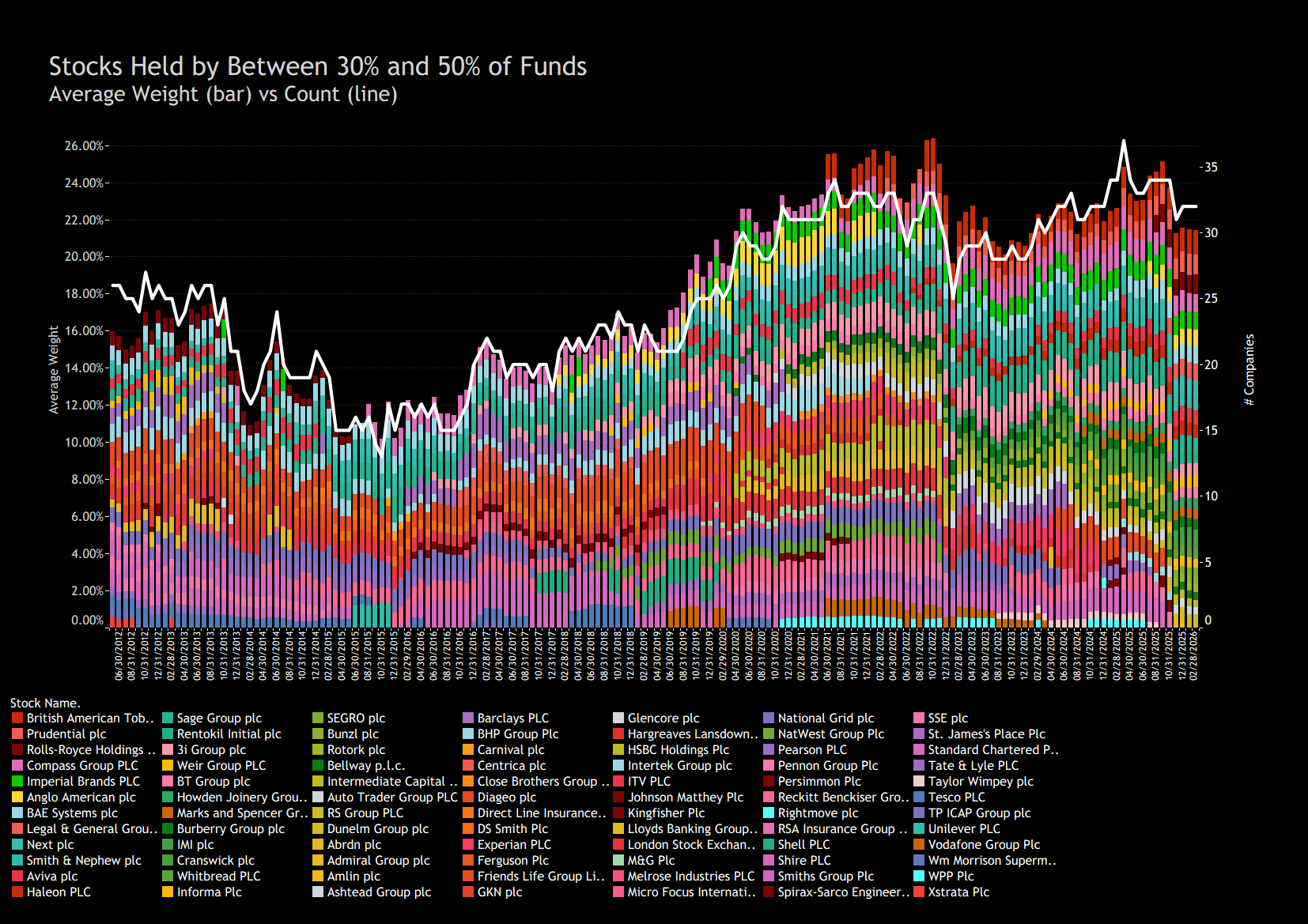
The 30–50% ownership bucket remains relatively contained, with the number of names typically ranging from the low-20s to low-30s. In total, only 84 companies have ever passed through this range since 2012, reinforcing how selective this part of the distribution is.
In weight terms, this group built into the late 2010s, peaking in the low-20% range, before easing back. More recently, its share has stabilised, but without reclaiming prior highs, suggesting less conviction being expressed in this part of the distribution.
30–50% Cohort: Snapshot & Turnover Dynamics
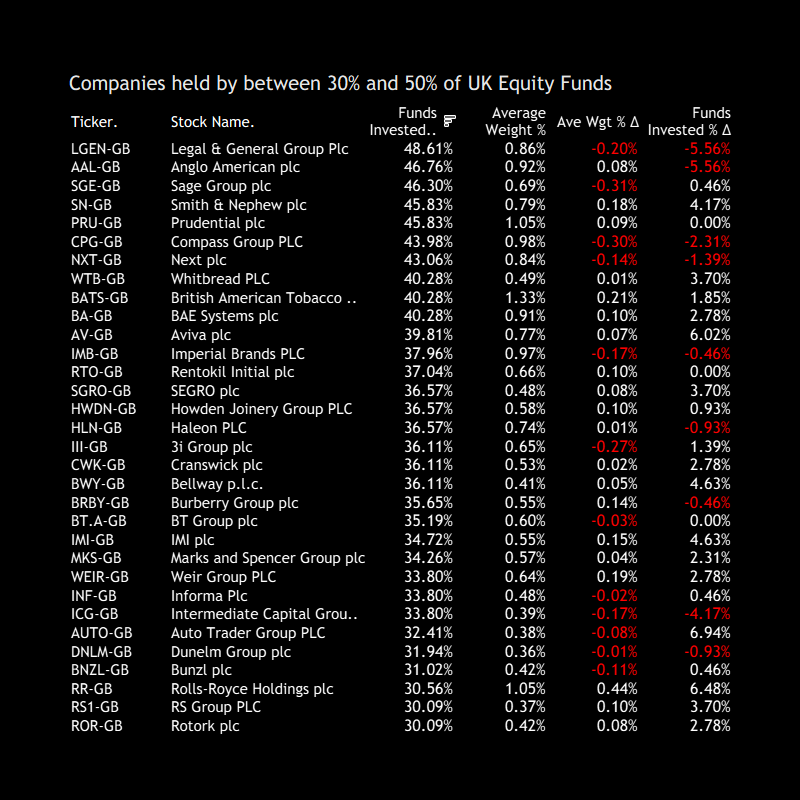
Current positioning within the 30–50% ownership range comprises ~30 companies. The cohort spans a mix of UK large caps, with representation across financials, industrials, consumer names and defensives. Position sizes remain relatively contained, with most holdings clustered below ~1% of average fund weight, and only a small number moving modestly above that level.
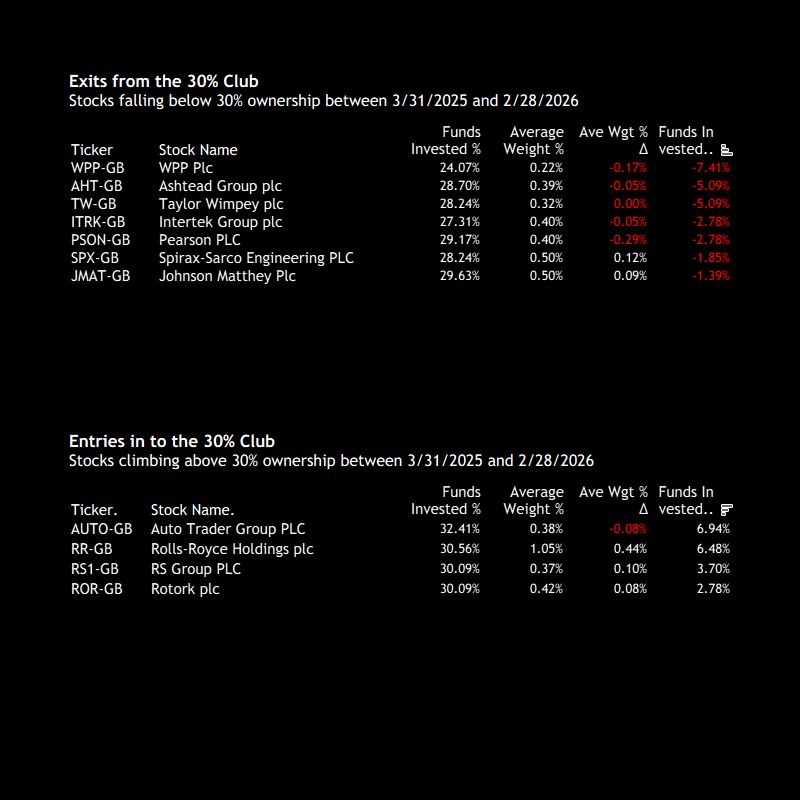
Turnover within the bucket is visible on both sides. A number of names have dropped below 30%, including WPP, Ashtead, Taylor Wimpey and Intertek. At the same time, new entrants have moved up through the threshold, led by Auto Trader and Rolls-Royce, with RS Group and Rotork also crossing into the cohort.
Diverging Paths Within the Middle Cohort
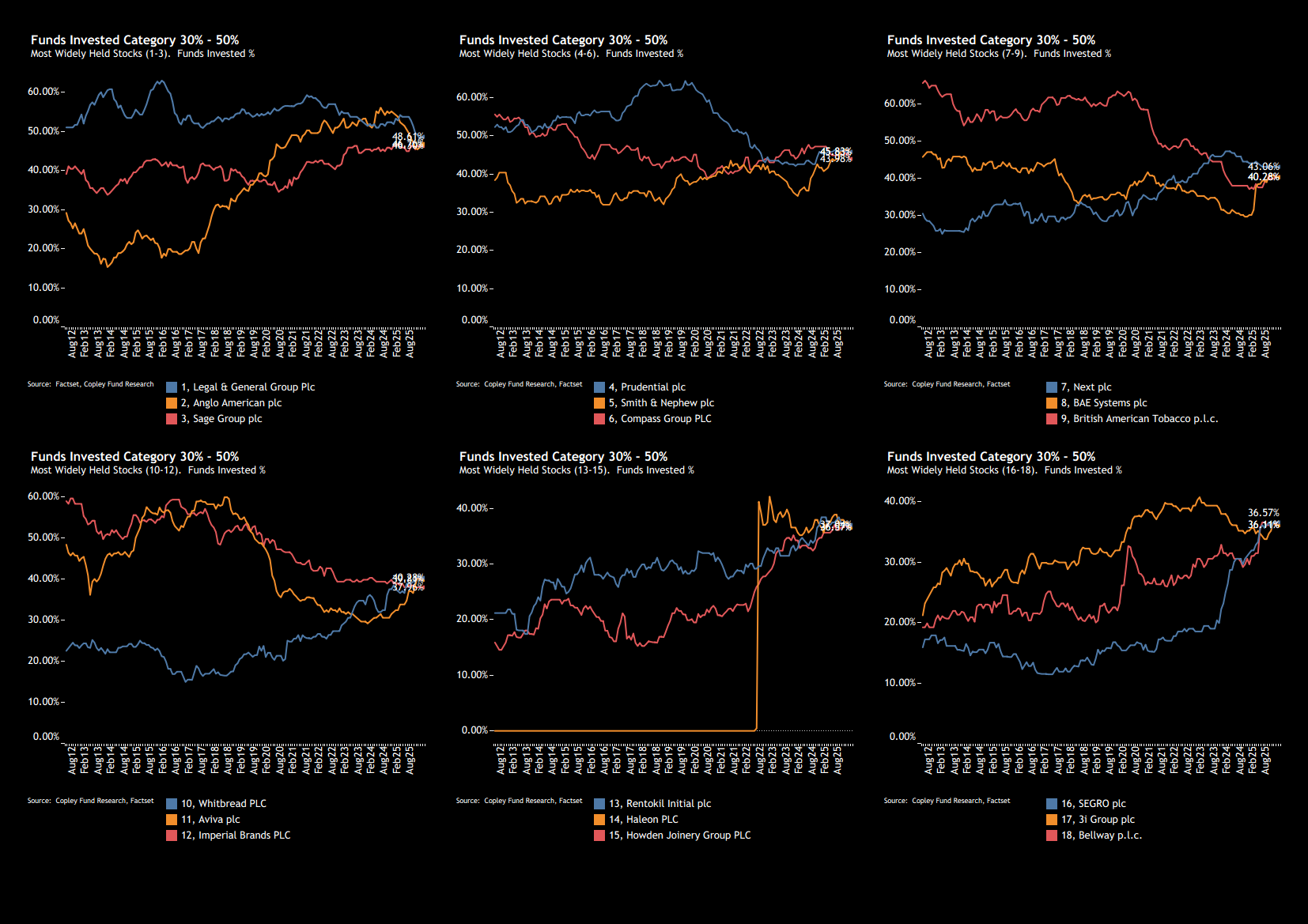
Ownership trajectories across the current constituents are varied. Some names have moved within relatively stable ranges over time, with participation fluctuating but remaining broadly within the 30–50% band. This is visible in names such as Legal & General, Compass Group and Sage.
Others show more sustained upward moves. Rentokil, Howden Joinery Group and SEGRO have all seen ownership build over time, pushing toward the upper end of the range.
In contrast, several stocks are below prior highs. Prudential, Imperial Brands and British American Tobacco have all seen participation ease from earlier peaks.
The 15% - 30% Cohort
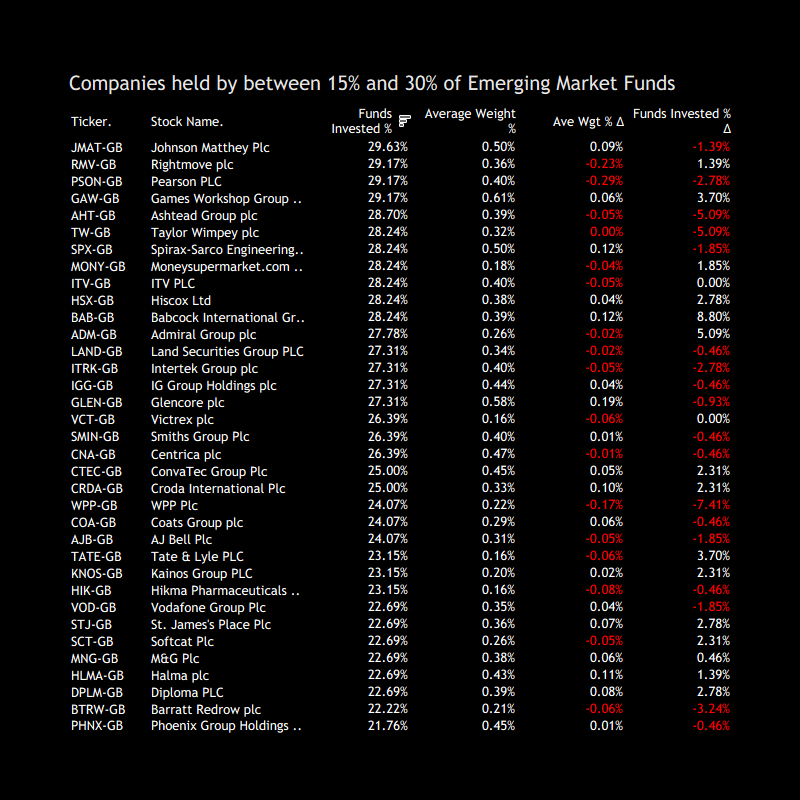
The 15–30% ownership bucket includes 85 companies, making it a meaningful layer within the distribution. The cohort spans a broad mix of UK names across sectors. Position sizes remain modest, with most holdings sitting well below 50bps of average fund weight.
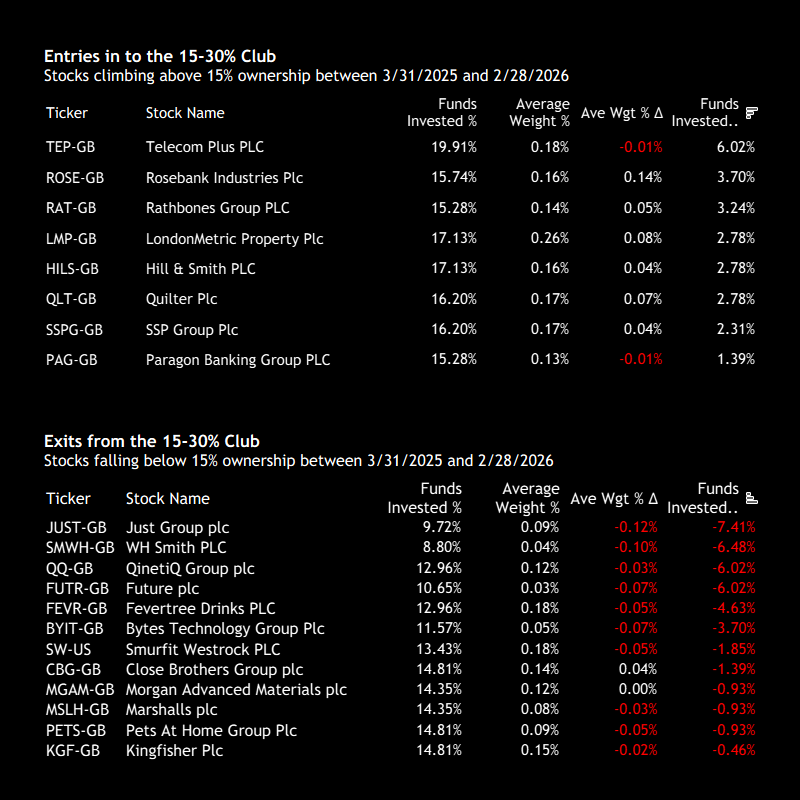
Turnover around the thresholds is active. A number of names have moved up into the bucket, including Telecom Plus, Rosebank Industries and Rathbones, alongside LondonMetric Property and Hill & Smith. At the same time, several stocks have dropped below 15%, including Just Group, QinetiQ and Future, as well as Bytes Technology and Close Brothers.
The 0% - 15% Cohort
The Long Tail
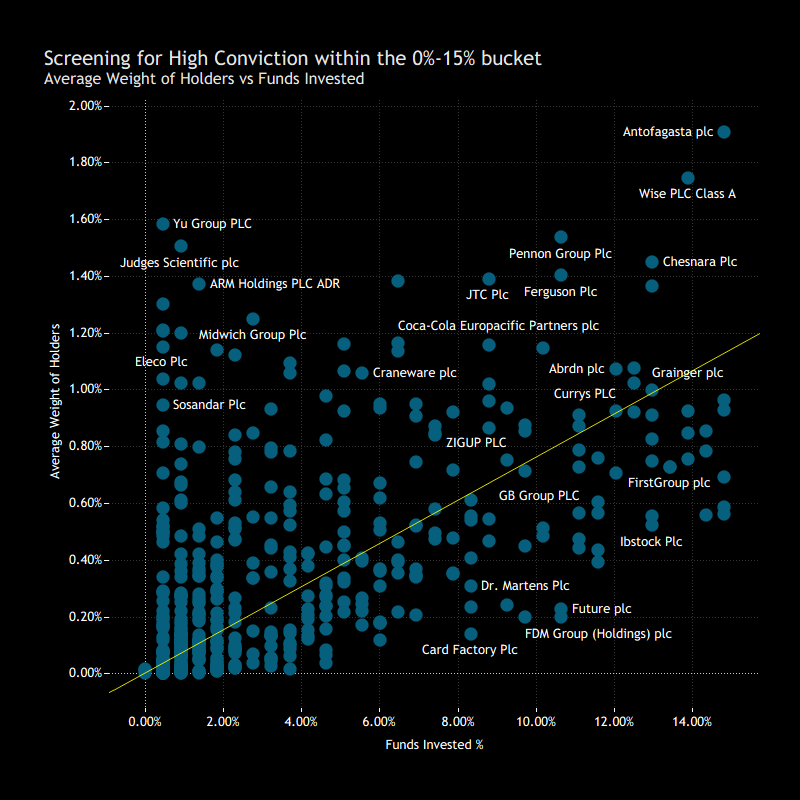
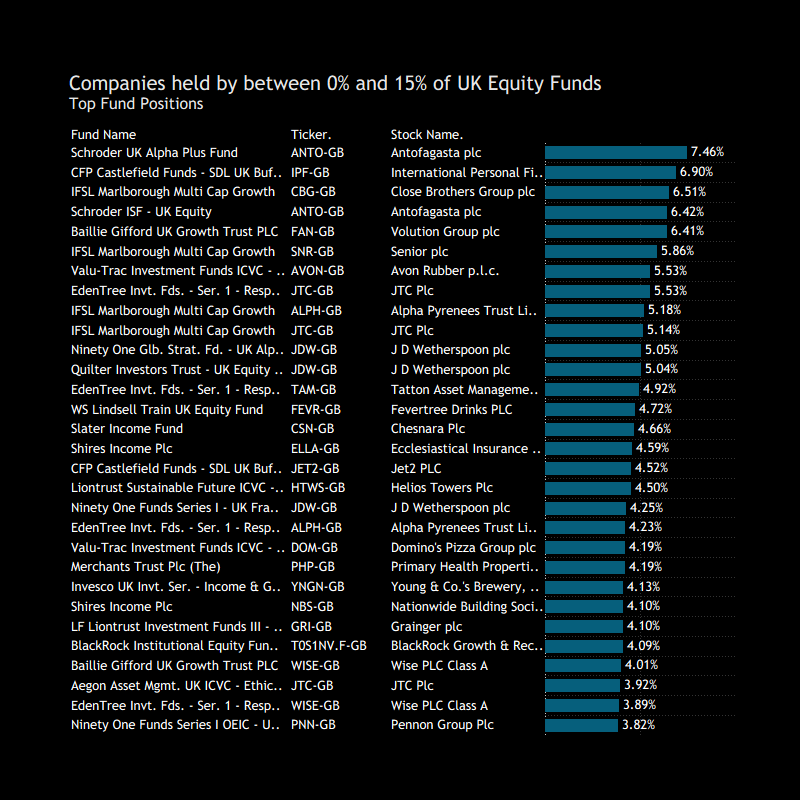
The 0–15% ownership bucket contains 896 companies, forming by far the largest segment of the universe. It represents the long tail of positioning, with a wide dispersion of names held by only a small subset of funds.
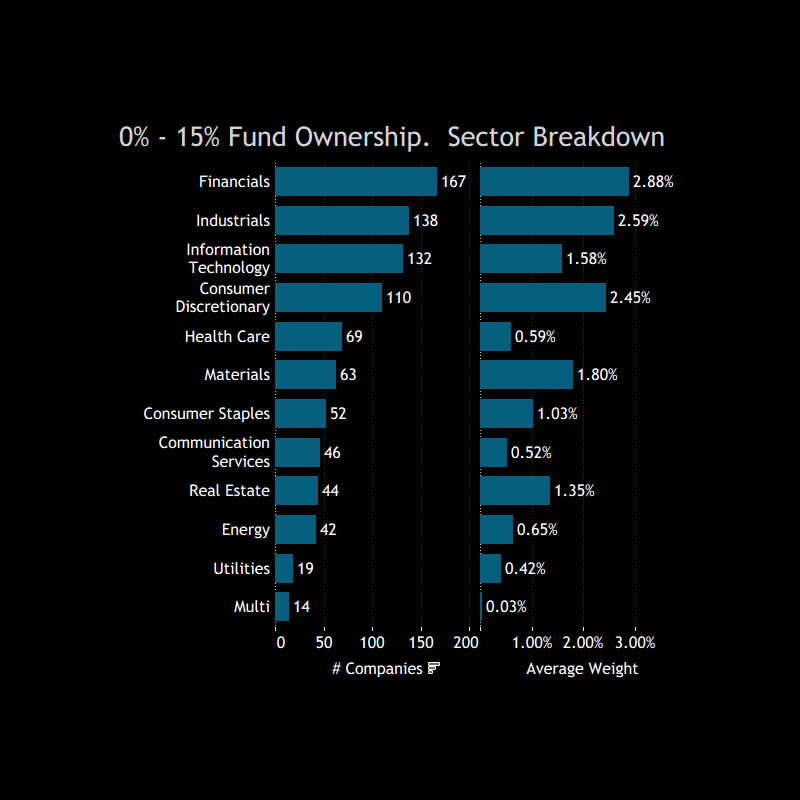
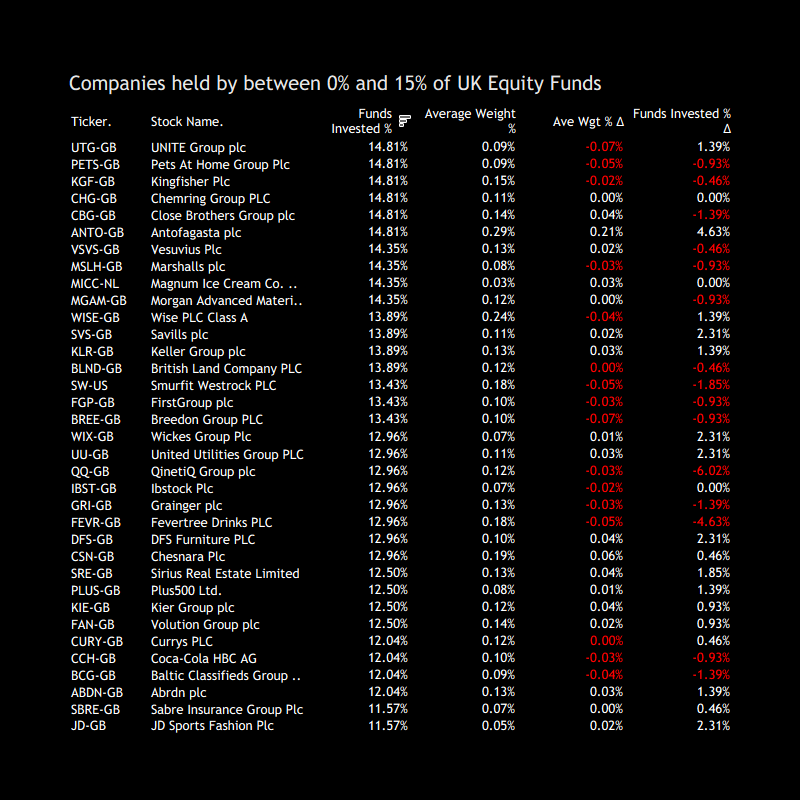
Sectorally, the cohort is broad but tilted toward Financials (167 names), Industrials (138) and Information Technology (132), with Consumer Discretionary also well represented (110). At the top end of the range, a number of names sit just below the 15% threshold, including Unite Group, Pets at Home and Kingfisher.
Conclusion
UK portfolios are becoming more focused, with conviction increasingly expressed in a broader set of consensus names.
The structure of ownership remains highly skewed, but the balance of capital has shifted upward — away from the long tail and toward the most widely held stocks. Entry into the top ownership cohort appears to follow a defined path, with participation accelerating once names reach critical mass, reinforcing crowding at the top.
Further down, the middle of the distribution remains relatively small and selective, while the long tail continues to account for the majority of names but a limited share of capital. Together, this highlights a structure where portfolios are concentrated in a smaller group of widely held positions, with the remainder spread across a large number of lower-weight holdings.
Related Posts
- Steve Holden
- July 19, 2024
UK Funds: Performance & Attribution Review, Q2 2024
260 UK Equity funds, AUM $185bn UK Funds: Performance & Attribution Review, Q2 2024 Summar ..
- Steve Holden
- August 27, 2024
Positioning Insights, August 2024
255 Active UK funds, AUM $189bn Active UK Funds: Positioning Insights, August 2024 Summary Heal ..
- Steve Holden
- May 16, 2023
UK Fund Positioning Analysis, May 2023
267 UK Equity Funds, AUM $184bn UK Fund Positioning Analysis, May 2023 Tobacco: Kicking the Hab ..